
Tuesday, August 23, 2011


"EMOTIONS 1-6" FEATURED AT GLOSSOM.COM
TUESDAY, AUGUST 2, 2011
Today I will talk about how to present their art on the Internet in a modern way and the benefits of doing so.
In my last post I talked about new ways to present art and design on the Internet. I was inspired to re-evaluate a collection that I suddenly sat up in the beginning of my membership without its further thinking about what a collection actually means. It is not about to present individual work of art but to create a whole that speaks of a certain topic and that is visually engegerande. Anyone who is inspired by what they see has easy access to the individual images as collection consists of. I was rewarded for my efforts for the six-part series "Emotions 1-6 '(small handmade collages from 2003) was released today on the main page! I also got one thanks to a co-founder, Piero Rivizzigno, because I publicly commented on the creative possibilities that it might at first a bit daunting grid, collection's structure, give supplied. It's fun and encouraging to ever get feedback! Read more about the idea of collections at Glossom here. (www.glossom.com)
"I Think That The Way in Which you an really focus on a subject matter or a mood is interesting, and Not possible through Other forms of picture viewing online (slideshows and the like). For instance, I have found That I can more readily presented the Various Aspects of my art in terms of specific emotional states of being, not just moods. It Is Also quite interesting to see what sort of new "image" You Can Create Using all the familiar elements of your pictures - there are some times nice surprises and revelations That allow a new look on old material. We thwart get too fund of Our Picture As They Are, so we May find picking out details a Difficult but nonetheless useful task. Thanks for Providing this opportunity!" (my comment).
In my last post I talked about new ways to present art and design on the Internet. I was inspired to re-evaluate a collection that I suddenly sat up in the beginning of my membership without its further thinking about what a collection actually means. It is not about to present individual work of art but to create a whole that speaks of a certain topic and that is visually engegerande. Anyone who is inspired by what they see has easy access to the individual images as collection consists of. I was rewarded for my efforts for the six-part series "Emotions 1-6 '(small handmade collages from 2003) was released today on the main page! I also got one thanks to a co-founder, Piero Rivizzigno, because I publicly commented on the creative possibilities that it might at first a bit daunting grid, collection's structure, give supplied. It's fun and encouraging to ever get feedback! Read more about the idea of collections at Glossom here. (www.glossom.com)
"I Think That The Way in Which you an really focus on a subject matter or a mood is interesting, and Not possible through Other forms of picture viewing online (slideshows and the like). For instance, I have found That I can more readily presented the Various Aspects of my art in terms of specific emotional states of being, not just moods. It Is Also quite interesting to see what sort of new "image" You Can Create Using all the familiar elements of your pictures - there are some times nice surprises and revelations That allow a new look on old material. We thwart get too fund of Our Picture As They Are, so we May find picking out details a Difficult but nonetheless useful task. Thanks for Providing this opportunity!" (my comment).
NETWORKING IN THE ART WORLD ON THE INTERNET
New ways of networking and presenting one's art on the internet pop up all the time. I was recently invited to Glossom which is Eurocentric and apparently seeks to attract a discerning circle of artists and others who work with art and artists. You can create small collections such as this one from photos of our cats in the snow during the cold winter of 2010 in Finland. You can pretty much control the artistic design by reducing or enlarging images, repeating them and focusing on details. In this collection I have worked with diagonals I also noticed that I was able to concentrate on relatively narrow topics by using details from just a few images. In this way, I have been able to emphasize that I make art about different emotional states (which is often a bit difficult to deliver to the audience) and thus show the themes I have focused on in my collages and photos.
You can also add "mood boards" (mood boards) and small virtual books for inspiration.
You can also add "mood boards" (mood boards) and small virtual books for inspiration.
All such work and networking is extremely time consuming and I often wonder if there is any point. to it I nowadays have to try not to get too involved in a lot of groups of mutual admiration that doesn't lead to anything concrete. On the other hand, the Internet is a way of reaching out and if you want to be taken seriously as an artist, it's a good idea to use the various options available online. There are also many virtual magazines ("e-zines") that you can participate in. Glossom is fortunately an active center as they pick out art of interest and promote on Facebook and Twitter. It's better than many other places where your images are just sitting and disappearing in the crowd. Two places it may be worthwhile to upload art and photographs are on Flickr and Facebook, for some reason even old pictures get many visitors (without necessarily being contacts of yours). Potentially this exposure can get you little jobs and commissions, and may be helpful when you're applying for work.
There are also networks that charge for the membership, you need to be careful about that as they may promise lots of advantages that never materialize. In the UK, Axisweb is supposedly worthwhile but I haven't tried it yet (it's a whopping £ 30 for a year's membership). Saatchi Online is one of the most famous online galleries that people often use as their own website, and they have competitions and opportunities to sell originals or prints without having to pay anything for it.
There are also networks that charge for the membership, you need to be careful about that as they may promise lots of advantages that never materialize. In the UK, Axisweb is supposedly worthwhile but I haven't tried it yet (it's a whopping £ 30 for a year's membership). Saatchi Online is one of the most famous online galleries that people often use as their own website, and they have competitions and opportunities to sell originals or prints without having to pay anything for it.
The idea of using details and animating still images comes through very well in this video done by a Flickr contact: Marco Fritz: This grip makes the spectator curious and interested to see the next frame!
Originally written on
MONDAY, AUGUST 1, 2011
ARTISTIC COLLABORATION WITHIN THE RELATIONSHIP
MONDAY, JULY 25, 2011
Firstly, being in a relationship that revolves around art has re-ignited an interest within me. I feel that my life is heading back towards the arts after a long period of other concerns. My initial studies in art history (about three years in total) when I was very young were successful enough but I then went onto making art myself while intellectually speaking being more interested in spirituality. Now it's all coming together in a new synthesis.We've talked a lot about working with joint artistic projects, but we have not had time to realize the more subtle ideas. One way in which we regularly engage in co-operation is by being each other's critics and mentors. Usually it's about to reading each other's articles and artist statements. Martin has worked extensively on large project run by British Airways for the Olympics in London in 2012. Twelve of their airplanes are to be decorated with one design. Regardless if he is elected or not, the project has given him a new skills and something to show for. I pressed him on what he really wants to say with his art and it has become an interesting exchange on the synthesis between the material and immaterial sphere (physical and spiritual) which in a sense could be applicable to the contest theme. The advantage of having an artistic partner is that you can start a discussion about art and ones own intentions any time at all. We need to encourage the other, but also pressure them just a bit where you see that the others could do even better. There is no point in just patting each other on the shoulder with a lame "yeah it's really nice honey." This is extremely important when it comes to art because it is about reaching other people through as clear a communication as possible. No one wishes to hear or watch something vague and watered down.
We filmed a presentation video (which was not obligatory but something the panel encouraged you to do) with my simple Nikon D90 camera, and Martin has put together everything in Windows. In comparison with many other artists in the videos (many a bit waffly) I think Martin is straightforward and succinct as he sticks to the brief and the questions asked. It's meant to be a presentation of him as a person, not so much about the ideas he has for the design.
We filmed a presentation video (which was not obligatory but something the panel encouraged you to do) with my simple Nikon D90 camera, and Martin has put together everything in Windows. In comparison with many other artists in the videos (many a bit waffly) I think Martin is straightforward and succinct as he sticks to the brief and the questions asked. It's meant to be a presentation of him as a person, not so much about the ideas he has for the design.
Perhaps the fact that I walk around with my camera and often shoot Martin has made him more at ease in front of it. He would need that confidence during the job. Martin is a "second generation artist," and we hope that he will not be subjected to age discrimination. There is a tendency in the art world to encourage young talent but I hope that Martin will join the "the-strong-in-their-50s-group.
Watch Tracey Emin's example video about the meaning of art!
I know of two couples who make art in an intertwined way which makes it impossible to tell which bit was created by which party. Gilbert&George, the famous gay couple from London, and a successful couple Elena&Michel Gran from Russia. Martin and I hope to do a collaborative piece based on a book of poems about the wives of famous men distributed during the great book distributing event last spring - it was given out by a gallery who will create an exhibition of the works.
THE ESSENCE OF SELF - MORE ABOUT IDENTIFYING ONESELF
THURSDAY, JULY 21, 2011
 |
| Self-portrait after heartache, 2009 - Is this me or a pastiche? I thought of a portrait of my glamorous grandmother when I took this, it was not a conscious imitation, but an attempt to get away from my typical way of putting myself in front of the camera . |
To explore the self, is my artistic mission. Ultimately the aim is to construct and deconstruct the self, to use what feels authentic from a subjective point of view but also look at what I am I expressing outwards with a certain objectivity and see how I could go beyond my comfort zones and limitations. It might be healthy to question one's own identity and see how one might be able to intervene more actively in order to manage one's own development in more constructive directions. What in my life and my artistic expression works well and what is limping?
There is no permanent self. When I began keeping a diary many years ago I attempted to catch myself in that fleeting moment, at best once a day. 24 hours represents the temporal structure that no one can escape. The only thing we do know is that the day begins and ends at 24 hour intervals. Within the framework of this period, we try and cram in all that helps us identify ourselves. How we sleep, how we eat, how we work, how we organize our environment, how we love, what we hate, how we are happy, how we are depressed, how we distract ourselves, and so on. Some people hate themselves, others glorify themselves. To have a truly healthy sense of self is unusual. And if that is not enough quagmire, we must also try and relate to other people who have misconceptions about themselves, and seek to identify ourselves on the basis of how we relate to these people. How can we ever have a clear concept about who we are? The challenge of documenting the self as it "really is", even for a short period of time, was massive and it is not strange that I got tired ... I also knew that I would have to make compromises, including filling some holes in the story by using vague memories, and trying in an honest way to take only what I once long ago inculcated my minds as being a true story (I have clear memories of defining moments in my life while most of my past is hazy). Yet we are meant to be interconnected with the environment. Otherwise we would not have feelings. Emotions is an energy, almost a fluid, which conveys information between us and the external world (to put it simply).
Why was this so important? I wanted to feel that I do not live my life in vain, as a seed in the wind, without making a difference. It is challenging to live - for me there is no automation to hang on, but it all requires both deep thought and effort. It is demanding to be aware of the resistance of the body, or that life does not work like a machinery. I would like to help, but who? With what? I have to accept ignorance - my own and others! Some things depend on who I think I am, others on who I really am. In addition to various roles, there is a self that is relatively constant, a personality that is unaffected by external circumstances. But I can see that I move like a chameleon in relation to the world and what feels constructive. It is perhaps not so much about what I get from others as the point of contact you find when you encounter a common denominator. As Sartre pointed out, you become in the eyes of others. When you're by yourself, there are two options. You can either distract yourself so that you get away from yourself, or you may experience your self as intensified by thoughts, feelings and behaviour. By the end of the day, there no one who can say how much of the stories they tell themselves about themselves, is in fact fictitious.
It's not healthy to spend too much time on your own, you lose some perspective on the real world, ie. the reality we live in as a collective and that we agree on on the level of the collective consciousness. In the end, paraphrasing various esoteric ways of thinking, one might say that everything is a kind of fiction, one's own life is a creation created to illustrate different ideas or simply to have experiences just for the heck of it. Excessive self-consciousness (most people, however, go through different periods of this in their life) is negative while moments of happiness and self-forgetfulness is positive. "Truth" or the key to happiness is not likely to be at either end of the stick, but somewhere on the golden middle path, in synthesizing a paradox involving subjectivity and objectivity, negative and positive, in a harmonious balance.
It's not healthy to spend too much time on your own, you lose some perspective on the real world, ie. the reality we live in as a collective and that we agree on on the level of the collective consciousness. In the end, paraphrasing various esoteric ways of thinking, one might say that everything is a kind of fiction, one's own life is a creation created to illustrate different ideas or simply to have experiences just for the heck of it. Excessive self-consciousness (most people, however, go through different periods of this in their life) is negative while moments of happiness and self-forgetfulness is positive. "Truth" or the key to happiness is not likely to be at either end of the stick, but somewhere on the golden middle path, in synthesizing a paradox involving subjectivity and objectivity, negative and positive, in a harmonious balance.
 |
| Vivi-Mari Carpelan: Self-portrait as a bride 2010 |
When asked "what kind of person do you want to be?" I say "radiant", yet fully aware of the deep undercurrents that can take me to the exact opposite state of being. Also, that it can be almost impossible to resist the temptation to be an enfant terrible. "A better version of myself" is another desire that may seem quite impossible in practice when you realize how vain it is to force internal change. Change has a tendency to move in accordance with the laws of nature - the human will can only work as a start-up motor.
You can dress up in pretty clothes and pretend that your body is healthy, that you're popular and that life is a success. It can be comforting and uplifting. Disappearing in the masses is frightening for those who have begun to reflect on their identity. But is it me? Maybe it's me in the moment I think it's me. Yet, amidst all this, it is obvious to me that uniqueness, authenticity, and an ever-increasing awareness, whatever it means, is an end in itself, and how we go about achieving this is our way of life within the framework of this particular reality.
You can dress up in pretty clothes and pretend that your body is healthy, that you're popular and that life is a success. It can be comforting and uplifting. Disappearing in the masses is frightening for those who have begun to reflect on their identity. But is it me? Maybe it's me in the moment I think it's me. Yet, amidst all this, it is obvious to me that uniqueness, authenticity, and an ever-increasing awareness, whatever it means, is an end in itself, and how we go about achieving this is our way of life within the framework of this particular reality.
 |
| "Ceci n'est pas une pipe" (Magritte). It's not me. These are not my regular clothes, the body does not look like this, and I do not fit into this particular landscape. It's just a photo. Or maybe it is me right now when I am thinking it? The life story must follow some sort of logic if we are to survive. Therefore we have to cling to different beliefs about who we were, who we are and who we can become.  "This is not a pipe", René Magritte 1928-29 ( From "The Treachery of Images") |
TAKING RESPONSIBILITY AND CONTRIBUTING TO BALANCE
SUNDAY, JULY 17, 2011
TAKING RESPONSIBILITY AND CONTRIBUTE TO BALANCE ...
 |
| "Time is Come Next", Photography copyright 2011 |
Ultimately, the more you take responsibility for your life, the more you contribute to a balanced world. As I see it, everything is terribly out of balance and one of the reasons is that everyone blames everyone else and that so many see themselves as victims in relation to others. I myself know that I have to struggle very hard not to fall into victim mentality because a lot of the time I simply do not have much strength to resist it. At the same time, I can also see that trying hard to resist various states of mind isn't very helpful; somehow you need to live through them and integrate whatever negative feeling that requires your attention. One can certainly become quite sick and tired of all the requirements that come from the outside as well as from within oneself. We ought to be so perfect but no one can be that way. There is so much one ought to prioritize! Not least taking care of the soul, of the body/mind complex, through meditation practices. When do you have time for all this inner work? There is too much to consider and too many decisions to make... it can get you quite desperate as you're scurrying around in a viscous circle...
 |
| "Hope's strong and fragile nature," copyright 1998 |
For example, it is especially hard for those suffering from chronic diseases to maintain some sort of balance in a world where everything - socially, economically, physically and mentally - is out of balance. A simple example is that disability pensions are not in any relation to food prices, housing costs, inflation, etc. And many of those who work with issues of an financial nature on a larger scale are completely devoid of empathy and thoughtfulness. This is something I really got to know of when I moved to a small town, Hanko in Finland, and was forced to seek social assistance each month in order to survive. It was a horrible rumba where I felt controlled by officials who were not even trained social workers. It's one thing to take this resort as a temporary measure, as social aid is designed for temporary needs. It is altogether different when one is condemned to do so for the rest of one's life when the national pension is too low. It was really much easier to survive back in the 90s. I could do art because I got some support from the state and society in general, and no one meddled with the way I chose to live my life.
My creative juices don't flow as well anymore because there is too much mental and economic pressure. We are not eligible for social benefits (only tax credits) so I have no longer had to deal with that kind of stress. Yet we are still living below the poverty line. When I married, I was "punished by the Finnish state ; the "symbolic" sum of 68 euros per month was removed from my already minuscule pension. A sum which hardly makes a difference to the state, yet to me it means I have no "pocket money". Together, we try to take as much responsibility for our lives as we can ... but it is not easy for me to keep depression at bay. I do not have a lot of good advice as how to keep spirits up and take responsibility for one's own life. I guess it is best just to stay aware of one's own motives. Giving up some militaristic control can be a good idea - as far as I can see it is something most people have trouble with. By the way, money does create happiness, you feel this acutely when you do not have it.
I do feel that the collective madness is reaching its peak ... we'll see how it goes.
My creative juices don't flow as well anymore because there is too much mental and economic pressure. We are not eligible for social benefits (only tax credits) so I have no longer had to deal with that kind of stress. Yet we are still living below the poverty line. When I married, I was "punished by the Finnish state ; the "symbolic" sum of 68 euros per month was removed from my already minuscule pension. A sum which hardly makes a difference to the state, yet to me it means I have no "pocket money". Together, we try to take as much responsibility for our lives as we can ... but it is not easy for me to keep depression at bay. I do not have a lot of good advice as how to keep spirits up and take responsibility for one's own life. I guess it is best just to stay aware of one's own motives. Giving up some militaristic control can be a good idea - as far as I can see it is something most people have trouble with. By the way, money does create happiness, you feel this acutely when you do not have it.
I do feel that the collective madness is reaching its peak ... we'll see how it goes.
FEELINGS IN ART - A THEMATIC EXHIBITION
SATURDAY, JULY 16, 2011

IN THIS POST I WILL TALK ABOUT A MAJOR ART EXHIBITION WITH THE THEME "FEELINGS", AND OFFER SOME THOUGHTS ON EMOTIONS IN ART. THERE WILL BE A LITTLE HISTORY AND REVIEW OF THE ARTWORK THAT WON THE CONTEST. AT THE END ALSO A NOTE ON BRITISH FOOD CULTURE ...
Both Martin and I got our artwork accepted for the annual " MOMA" (Museum of Modern Art) Tabernacle exhibition in Machyntlleth, Wales. "What is art?" A quote by Leo Tolstoy was the basis for the theme and at the awards ceremony the curators told us that Tolstoi answered the question as follows: "Art is not a craft, but the communication of feelings the artist has experienced". Of course it is a statement typical of his time and not a comprehensive explanation of what art really is (something that the curators doid not take a stand for).
Had we been aware we could have found out about the theme a long time ago and so we could have done something specifically for the exhibition, as many certainly do. In retrospect, when one sees the other artwork that was accepted into the exhibition, one tends to ruminate that some other work than the one one submitted might have done better. Well, c'est la vie. We recieved no price but at least we got in. Nearly 300 works by as many artists were displayed - a third was rejected by the jury.
Both Martin and I got our artwork accepted for the annual " MOMA" (Museum of Modern Art) Tabernacle exhibition in Machyntlleth, Wales. "What is art?" A quote by Leo Tolstoy was the basis for the theme and at the awards ceremony the curators told us that Tolstoi answered the question as follows: "Art is not a craft, but the communication of feelings the artist has experienced". Of course it is a statement typical of his time and not a comprehensive explanation of what art really is (something that the curators doid not take a stand for).
 |
| Moma Award 2011 |
 |
| This is my contribution, the collage "Some things should never be forgotten", copyright 2011 Sea and Water symbolize emotions and are often present in my work. The volcano is quite an obvious symbol of male aggression and repressed emotions. I'll leave the rest to the viewer, but there is more than this in a paradoxical way, it's also about a positive experience of masculinity and sexuality. |
 |
| My collage has been squeezed in a corner ... many small works were difficult to see because they were hanging too low or too high. Otherwise, I think it's nice with big shows and lots of art . |

A stern Welshman behind me ..?
 |
| Martin's piece is "The Longing of the Sea", he has also used the sea as a symbol of emotions. The background is digital, the figure painted in oil and tempera. |
Emotions are a tricky chapter. It is of course one of the broadest themes you can think of as emotions so often are present in the artistic expression. I think people tend to enter work that express very easily identifiable feelings, as they are probably more likely to be chosen than more subtle expressions. In this exhibition, there are quite a few portraits with emotional facial expressions, and bodies in different positions.
The expression of emotions of the individual became popular at the beginning of the 19th Century and found its way into the arts - it was the Romantic era. As with all trends, it's one that comes and goes in different forms. In the past, creating a painting took weeks and months (much like Martin's art as he's using the mischung technique). Expressionism, on the other hand, was the spontaneous expression of emotions using a very direct, fast and strong painting style. It is an art style that was fashionable about a century ago. Although there are always those who want to paint in the expressionist way and do so with panache, whether figurative or abstract, it tends more often to be a case of art therapy. As far as symbolism goes, I am well aware that the meaning of symbols is unfamiliar to most people. Allusions to the sea and water therefore usually go unnoticed, although an attentive viewer can have an intuitive understanding of them. Symbols can easily become ends in themselves and should only function as the support or structure of a complex content. In my art I would say that the whole is greater than the sum of its parts (the symbols). It is also more than just allegory or metaphor, as I am striving for deeper emotional meaning.
 |
| Eugene Delacroix, "Freedom leads people", 1813 |
Although the jury intended to take into consideration the feelings that (anecdotally) have been present in the creation of an artwork, even if the content may not be that emotional, I think such feelings are rarely obvious enough so that the jury with confidence will be able to say that "it was emotionally interesting." It requires more time, insight and intuition than many have during the curating of an exhibiton (I myself have acted as curator in the past, so I know what it is like). It is also common that the feeling contents run counter with technical ability as emotional eloquence normally requires a high level of skill. Many of the most acclaimed works were in fact more aesthetically pleasing than emotionally expressive.
As expected, the winning work was an expressive portrait with a strong facial expression. There were some anatomical problems with the hand, possibly as a result of the painting's presumed spontaneity (though I must admit that the hand bothers me). In and of itself an interesting ambivalence was present, and the emotional expression wasn't too obvious as it was pointing to a complex and perhaps conflicting inner experience that seems to stand outside time and space. The colour scheme is interesting and suggests internal conflict as well. We noticed that most of the artwork were drab, and we think it has more to do with Wales than with a desired artistic expression.
 |
| Marcelle Hanselaar (photo MOMA ) |
Second prize went to another portrait in the Renaissance style that the judges felt had a mysterious "Mona Lisa Smile". This to me starts to sound like clichés. I also think that the idea of painting the facial details neatly but the clothes in a sloppy and badly painted way is a frequently seen style, a way that I do not think is particularly effective. The picture feels a little "derivative" as Martin and I always say.
 |
| Serena Jones (photo MOMA ) |
As the third prize, I would probably have chosen something other than an image that looked as if it was drawn back in the 1930's ... The feeling seems to be more present in the expressive charcoal drawing than in the content. No, no great art in this sketch, no.
 |
| Jill Cope (photo MOMA ) |
It's nice that the children are encouraged to be creative within the framework of a serious gallery. I have absolutely no experience in children's art but it was still pretty obvious that some children had received guidance from parents or other adults. Another problem is that what looks interesting in the adults' eyes often has come about accidentally as children do not see the world the same way as adults do, and generally create in a lot more subconscious way.
 |
| Ayesha Woodward (photo MOMA ) |
In this work by a 9-year-old the decorative foreground feels like a random phenomenon. Martin and I thought an atmospheric picture of a rainy day in Wales by a 14-year-old seemed genuine and spontaneous.

An additional prize will be offered and it is the visitors' choice. I nominated an installation of a bra with ambivalent text that I thought was quite handsome and a less obvious choice. In the class under 18 year olds.Martin and I both nominated the same picture by the 14-year old above.
On the whole, I must say that the artistic level was quite high and not bad for a provincial gallery, and once more I see that people around here are very artistically talented. It's all of us poor wretches who want to make art but can not afford to live anywhere else. (Perhaps I should point out that Martin has not always been this poor, on the contrary. But to do that you really enjoy is not always lucrative, we do need more than just good will). However, I felt that I once again ended up in a competitive stance and it felt a bit uncomfortable. It is easy to slip into negative thoughts about how much better one should be or whether one should really carry on with the task of being an artist.
Finally, I must comment on the nibbles that galleries often offer here in the UK. There is always wine. At lunch time, it is often a sandwich and chips. Unfortunately, it's always the classics:, i.e. cheese with raw onions (ugh), egg and cucumber, tuna and various forms of meat that we don't eat. Why salad is added to the meat and not the vegetarian options is an insoluble mystery ...

WHO IS OPEN FOR COMMUNICATION? IS THERE A PLACE FOR DEEP ART?
FRIDAY, JULY 15, 2011
 |
| Vivi-Mari Carpelan: "Bad Communication", abstract digital photo 2010 |
It is now fashionable to be an artist, and whether one is a professional artist or someone who is not able to go past the level of amateur ship, everyone is fighting for the same position in society. In general, we all crave recognition. We all want to communicate and tell about ourselves. It is an age of individualism - in fact, we may already have reached the peak. The problem is that everyone has something to say but are so busy and often self-preoccupied that they do not have time to listen to others. I think people are becoming more and more overwhelmed by the never-ending flow of information, it becomes harder and harder even for normal healthy people to filter the information and to make decisions about what is worth to giving attention to. There is a lot of negative stress.
To counteract this, I don't think there is any other solution than to take time to think and consider one's priorities. Firstly, it may be worthwhile asking oneself whether one wants to be self-centered and selfish or compassionate and generous. How should one proceed? You have to decide how you want to express who you are. As for artistic expression, it may be that you need to be really honest about yourself and see if it might better to keep creative pursuits as a hobby and not enter an already overcrowded market. It is generous to provide space for those who really have something to say and who have the required talent. I know it seems like an impossible task to even decide who is truly a good artist, but see it as a thought experiment. If you do not want to be totally self-absorbed, you must also be able to receive from others; this is an important part of the soul's development. On top of this, you need to be able to support and encourage those who have something important to give.
 |
| "Bla bla bla ... I need a rest," handmade collage 2008 |
Especially here in the UK, I feel that one is not being taken seriously if one mingles with amateur artists and exhibits in spaces that you get for free. On the contrary, you have to present a list of all the commercial galleries you have exhibited in, and on top of this you should ideally have a social message and be prepared to work with socially-oriented projects in schools and nursing homes. It's demanding a lot of an artist and if you do not meet all of these external criteria you may receive no grant money, either. To top it all, you need time and effort to market yourself (in practice there are many who elbow their way and it is the extroverts who are getting anywhere), and you will easily be seen as arrogant if you are not very communicative with everyone you come in contact with.
If you use the Internet, generally speaking you get attention only if you give it to others (and in practice it usually means giving energy to groups of mutual admiration or offering bland comments about pictures that are more than mediocre - this type of exchange is often quite useless). It is not always the will that is the problem, the problem is to be physically able to be deeply creative while managing all these threads. We need help, not demands!
No matter how talented you are, it is not enough if you do not have a lot of money to spend on exhibitions at prominent galleries and energy and interest to engage the body in social projects. I have neither the money nor sufficient health and strength for all this. My husband also feel that there is no place for him because he "just" wants to paint pictures. Yet we have much to say. It's as though we are standing and crying out while nobody hears us. I do not mean that everyone needs to like what we do, but we are serious and tech savvy enough to be able to express what we have on our hearts. I think there should automatically be room for us. Though there is of course the possibility that it is only we who think that our message is of importance. If so, then we might as well just stop trying to reach out and be content to keep creative expression as a hobby.
If you use the Internet, generally speaking you get attention only if you give it to others (and in practice it usually means giving energy to groups of mutual admiration or offering bland comments about pictures that are more than mediocre - this type of exchange is often quite useless). It is not always the will that is the problem, the problem is to be physically able to be deeply creative while managing all these threads. We need help, not demands!
No matter how talented you are, it is not enough if you do not have a lot of money to spend on exhibitions at prominent galleries and energy and interest to engage the body in social projects. I have neither the money nor sufficient health and strength for all this. My husband also feel that there is no place for him because he "just" wants to paint pictures. Yet we have much to say. It's as though we are standing and crying out while nobody hears us. I do not mean that everyone needs to like what we do, but we are serious and tech savvy enough to be able to express what we have on our hearts. I think there should automatically be room for us. Though there is of course the possibility that it is only we who think that our message is of importance. If so, then we might as well just stop trying to reach out and be content to keep creative expression as a hobby.
It's no use trying to communicate with the outside world if nobody wants to listen. I wonder who really is sufficiently coherent, centered and interested to have the receptive faculty for deep and meaningful communication? Who are able to be thoroughly present for this to be possible, and not divided and distracted by the fatal combination of "stress and entertainment"? Who even has curiosity that goes beyond the old and ingrained thinking? Currently, I am quite disillusioned. However, I invite others for discussion if there is anyone out there who wants to chat about art and the meaning of life.
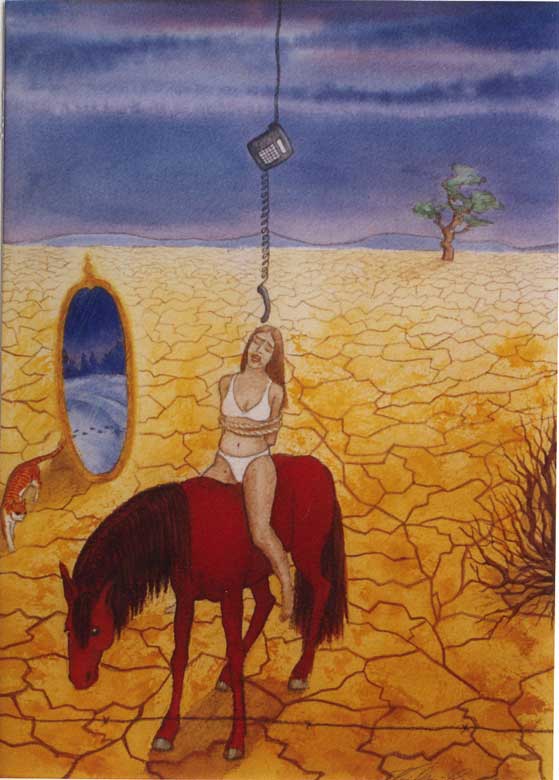 |
| "Hallååå ..?" copyright 1998 |
Subscribe to:
Posts (Atom)