Showing posts with label despair. Show all posts

Wednesday, May 7, 2014

THE TRAP OF TRYING TO PLEASE "ALL THOSE OTHER PEOPLE"

Photograph by Vivi-Mari Carpelan
Most of the time I have pretty extreme doubts about my art, and it hampers me a lot. What I try and do artistically is of such great importance to me, I just cannot take it lightly. Because of chronic illness it's the only thing I'm able to do in order to feel accomplished. It is in this respect my day job (I spend an average of five hours a day on creating,  still I feel it's taking way too long to "get anywhere"). I also feel very driven to make a difference. Some money out of it all would of course be welcome, but I can just barely survive without it, and so don't make it into a priority. Life is stressful enough as it is.

However, I don't have a degree in fine arts and my line of thoughts and feelings run counter to those of the average art world. The blankness, rejection and general lack of encouragement is deadening to say the least. There was a time when I was successful with the general public, but times have changed. Today, there are more artists who compete for attention. My own art has changed and may not be as easy to take in as it was twenty years ago. People's habits in regards to consumption have changed. The internet has changed the way we view art because there's so much of it readily at hand, and information about exhibitions is also easily available. There's simply too much choice, people get overwhelmed. The collective consciousness is even more ridden with urgent challenges, and we are made increasingly aware of various forms of threat through an increasing variety of sources - art is seldom seen as a necessity in times of great upheaval. However, it's also in times of great upheaval that great art is often made, but the artist's contemporaries will no doubt find it difficult to distinguish greatness from the ordinary. It may take some perspective to perceive that which is truly meaningful and significant to the overall collective mind, and it's perfectly possible that no one will.

When I arrived in the UK and took up art again I soon realised just how competitive the art world has become. All bigger open exhibitions are connected to awards, and if you don't win them you're not considered a good artist. However, you probably won't win any awards unless you have a degree in fine arts. As an artist, you end up depending more and more on other people's opinion and criteria, and it can affect the way you make art. This will result in more mediocre art. What I see is that a lot of contemporary artists are not intuitive and true to their souls, but people pleasing and calculating. That's why so much contemporary art is so crap. For instance, everyone knows that art with a social message is more highly regarded than say expressive emotionalism, so young artists try and bend their minds towards a strategy of socially engaged conceptualism that satisfies the art world. Art with a social message is only good art if it comes from a deep place. But of course commercial art that is purely decorative is just as bad. Most people (i.e. the average person) are complying with rules and regulations, thus supplying more mediocre art to a world that is replete with blandness.

The lack of support and encouragement threatens to kill my spirit. I may not be making great art, and it certainly isn't always good... However, you would think that people had a heart and remembered the moral of smiling at least once a day at the person at the cashpoint or a random person at the bus stop. Make their day! Well, artists also need a "smile" to keep going. Be a good human being by being generous and kind to those who are struggling to do what they are destined to do, regardless whether they are making a huge contribution to society or not. Support will help them get better at what they are doing, and it's potentially for other people's benefit too. No one is an island.

If I ceased trying to get my art out there to the attention of the general public and art authorities, and focused on being creative on my own terms instead, I might get some kind of peace of mind. However it would also damage my desire to communicate and certainly ruin every chance of ever "making it" while still alive. Seriously - I'm in two minds about this. I'm driven to communicate so withdrawal doesn't seem to be the answer. No one likes rejection and some of us are more prone to suffering from it. It can hamper you so badly, that you just give up. You don't know for sure if you're making good art or not because you're not getting much validation, and it could mean the end of a really promising path (I rather say "path" than career). After all, a lot of writers and artists have struggled for quite a bit before making it. Often they had very little support until they were suddenly discovered by an authority who resonated with their work. 

There was a recent TED talk with Elizabeth Gilbert, the author of "Eat, Pray, Love" who struggled with rejection for years until she made it. However, in this case we seem to be talking about stuff that's fairly commercial - I don't know about the book, but I saw the movie and it's pretty cheesy. I know that in the end it doesn't matter what you do as long as you do it creatively and with integrity. It really doesn't matter what you do, because there should be room for everyone in our world (that's what true diversity should be all about). However, if you're not looking for commercial success you may end up lacking in some drive. After all, who are you supposed to communicate with? What does success look like to you? It can be hard to imagine if you remove the rather straightforward commercial aspect, and so you may end up feeling pretty scatty and unfocused. You might have to think consciously about how you can bring yourself back to your own inner centre. Even when you are doing what you love, it's never an easy ride and a lot of the work you have to do is tedious and uninspiring. It's a little bit of inspiration and flow, and a lot of hard work. To remain in touch with your soul throughout all this is definitely not easy. 

Every once and again I cry for a day and then pick up again when I got the sadness and frustration out of my system. I lick my wounds and consider that people might just be too stupid to get me (I know you shouldn't, but... I'm only human). I think of ways in which I can minimise exposure to disappointments, including trying too hard to get noticed. Trying too hard to gain attention is not a natural and fluent way of existing. I remind myself of the Taoist ideas about going with the flow along the lines of the least resistance. Take the watercourse way. Nowadays I also meditate at least once a day (three times would be better). Though it's sometimes a fruitless pursuit, it seems to be the only way in our chaotic world that one can regain some inner balance and poise. My husband then reminds me that my job is to make art for the future. It may not please society we know today, but it just might point the way in some way... I guess what I really want is to help people reflect upon the great pathologies within the collective psyche, and trying to be different is to go against my deepest concern, and it's a spiritual one which I'm well aware doesn't sit well in postmodernist society. I'm neither particularly clever nor geeky. Perhaps one day it will be appreciated in spite of all its shortcomings. 

This blog post was inspired by another one from "For the Creators".


Tuesday, April 3, 2012

RELEASING TWO PIECES OF ART FOR "PROJECT X"


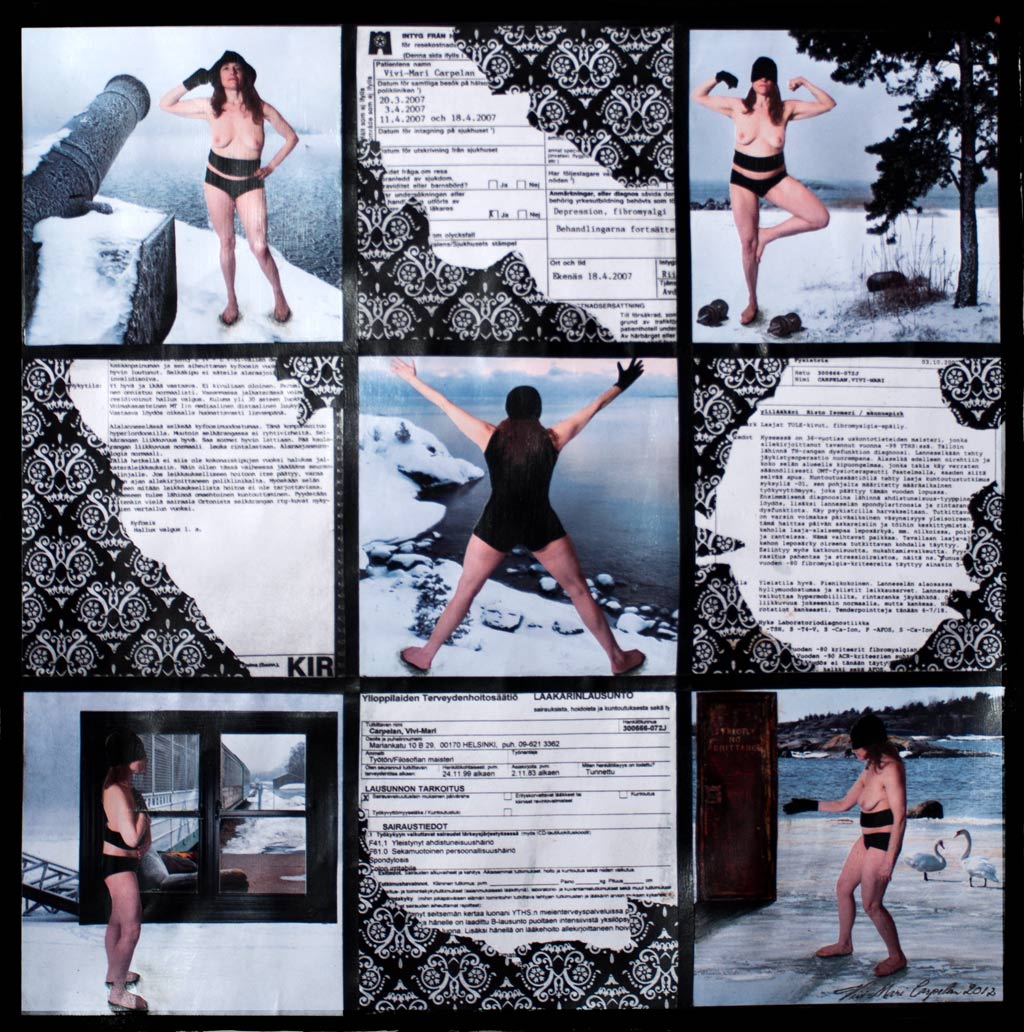
Vivi-Mari Carpelan: "Affected by X I (1/2)", copyright 2012
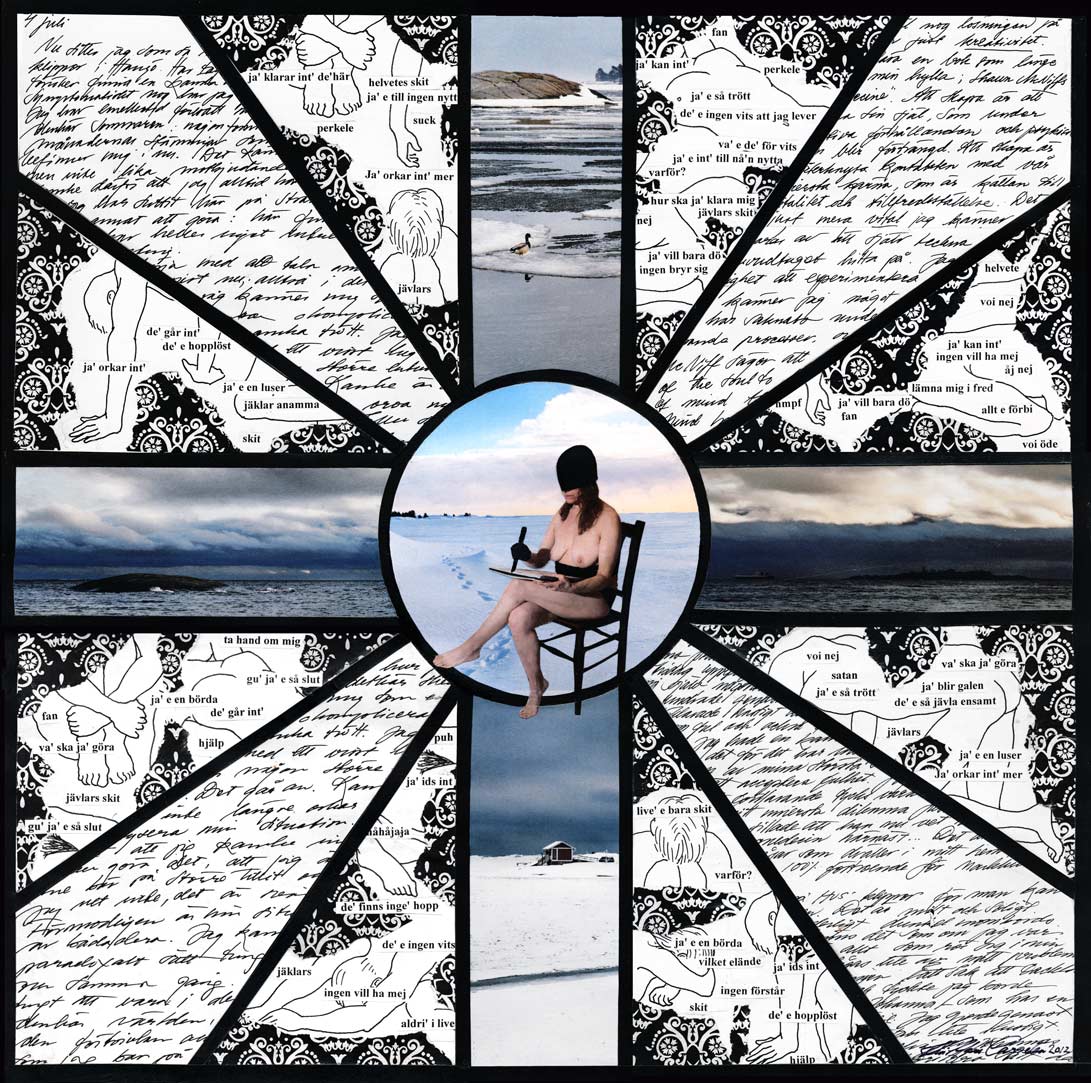
Vivi-Mari Carpelan: "Fragmented by X II (1/2)", copyright 2012

So... after a considerable amount of scanning, fixing flaws on the scans, and stitching all together, I am now ready to release these two recent collages into the world... Having said that, the process was made easier by the fact that I got a scanner for free from Freecycle that is about as good as the old one but is compatible with my reasonably new laptop! It's not a flat one like the really crappy one we tried a year ago. It needs to have space for some depth of field. The only thing is that my laptop is starting to have problems with big files. It's constantly freezing up and it's driving me up the wall... 


I wrote some about the first piece in a previous blog post. The the two pieces, which are two aspects of the affliction with X, feature photos of myself, photos I've taken of the Finnish winter by the Baltic Sea, some medical reports from Finland about my condition and pages from my diary. The pieces is about strength and weakness. The black garments represent the affected areas. The medallion "wallpaper" is as usual a symbol of "cover up", but the cover up is always as elegant as possible so as to counteract what really goes on beneath the surface (pain, fatigue, despair, hopelessness, discomfort, negative body image, etc).

In the first piece, "Affected by X", I'm talking about the dual, conflicting aspects of invisible illness.

Firstly, I think it's quite clear that the condition is not very obvious in these photographs though it's physically present and possible to detect. There is something not revealed as I am partially covered up in black fabric. Not only is it the affliction not obvious, but I also don't really want it to be obvious. Perhaps life would be easier in some ways if people could see what was wrong. On the other hand, most people instinctively strive towards blending in with other people, and not standing out as abnormal. The first conflict is thus the one where a person wishes acknowledgement that they are not up to living a normal life, yet also choose to hide it as much as possible for fear of becoming an outcast, "thrown on the dump". 

The second paradox is that while one is sometimes obliged to give in to one's weaknesses so that one can pace oneself and not overdo the chores of daily life, one often also develops stubbornness and strength of character. Personally, I have always fought the humiliating state of being a weak individual and so the two upper images portray my attitudes of defiance, dignity and fighting spirit. 

Thirdly, there are medical reports that portray the various aspects of illness in an objective, detached way, which is in obvious contrast to the subjective experience of it. These two portrayals may be equally true yet not truly compatible.

The fact is, many areas of the body are affected but not all of them, or only very little. The head and the eyes are definitely areas linked with cognitive difficulties, but the idea of not seeing is also symbolic of inability to perform or the inability of being able to predict what the next moment or next day has in store. Living with such a condition enhances a lack of basic security, and even more so as medicine is of very little help. 

The second piece, "Fragmented by X", is first and foremost about creativity. Creativity helps you find solutions in every day life but can also help analyse problems and set the straight, as well as offer an outlet for frustration. The pages from my diary radiate outwards like rays of a sun. They talk about how I was frequently feeling, where I would go to sit on the cliffs by the sea in order to be inspired, but also about solutions and ways of enhancing creativity in a more theoretical light. On the other hand, entropy seems to be lurking around every corner. The drawings portray men and women whose bodies express fatigue and despair. The phrases that surround them are various complaints that people express in their heads or out loud. The reason these are in Swedish is because I feel I can connect with these ways of expression in a way I can't in English. They express things such as "I'm of no use", "I'm a loser", "I can't go on", "It's hopeless", "I'm so fucking tired", "I wish I was dead", "no one can help me", "goddammit", etc. When I was thinking of various exclamations and general complaints I actually started to feel really bogged down. This is how powerful negative words can be. So in this piece there is the positive strife for a more constructive and creative way of life, and the eternal struggle not to fall prey to hopelessness and despair.

The pieces, which are structured around the X, talk about my background through photos of the Finnish winter; the solitude of the shoreline, the rather harsh climate and the generally speaking rather unemotional environment. Still, it's also an environment that fosters what we call "sisu", i.e. a form of power of will and tenacity that is often considered peculiar to the Finnish. I feel that I can get away from it all in Finnish nature in a way that is not possible in the UK. The other aspect of my identity is the fact that the words are in Swedish. In my next piece, there will be words in English because that particular aspect of my life is one I tend to express in English. Underneath it all, there is a wish to consolidate the various aspects of my identity as I tend to feel rootless and insecure.

They are fairly large pieces and it was as usual very hard for me to focus and get it right. I had to do a lot on the computer, which is tiring, and then cut things very neatly, which is nowadays very difficult as one has to be able to focus well and have very steady hands. I know the handmade aspect shows, but crafting my collages by hand is one of those things that I don't want to give up because I feel that it adds emotional value to them.

POST SCRIPTUM: After some contemplation I have arrived at this summary about the two pieces:

The two pieces form a diptych about the fight against fragmentation of the body and mind. It's is part of a larger project called "Project X", an attempt to make invisible illness visible. X stands for many things, among others "crossing out" and "marking a spot" - here it often denotes an ailment unknown to the viewer. The two images feature photos of myself posing with black garments covering the afflicted areas and unable to see how my life might unfold due to the condition. There are photos I've taken of the Finnish winter by the Baltic Sea (the harsh climate is partly a source of the strength of will typical of people of the North - there is a paradox in that snow symbolizes emotional coldness but can also have a comforting quality), some coldly objective medical reports from Finland about my condition that contrast with my subjective experience, and pages from my diary. The "wallpaper" is a symbol typical in my art, as it represents "cover up".

The first image is about external strength and weakness, the second piece about internal ditto and more specifically about creativity that radiates from the centre. The grids represent the attempt to hold everything together in the face of the pertinent entropy and fragmentation that threatens the afflicted person on a daily basis.  The pieces also speak of a complicated kind of eternal cultural identity crisis and problem with belonging - this is represented by the presence of text in Finnish and Swedish, and the shape of the pieces are reminiscent of the Finnish and the British flags. For instance phrases that surround the drawn characters burdened with fatigue are various complaints that people express in their heads or out loud. They are in my mother tongue Swedish because I feel I can connect with these ways of expression in a way I cannot in English. They express feelings such as "I'm a loser", "I can't go on", "It's hopeless", "I'm so fucking tired", "I wish I was dead", etc. As I was thinking of various exclamations and general complaints I actually started to feel really bogged down - such is the power of negative thought.

'There is something not revealed as I am partially covered up in black fabric. Not only is it the affliction not obvious, but I also don't really want it to be obvious.'

Ultimately, I am on a journey of discovery - is it always possible to triumph over adversity? The challenges of my life have been many, and often I was faced by problems that seemed impossible to disentangle. Very often I did it nonetheless. I want to see if there is a way in which disability not only teaches us about humility, compassion and the value of diversity, but also has a place in a human life that would be lacking in intrinsic value if it was too perfect.