Wednesday, August 6, 2014

PLAYED ON BBC WALES!


My recent sound piece "Creativity Will Set You Free" was played on Adam Walton's show on BBC Radio Wales at prime time at 22 hrs on Saturday the 7th of June! Unfortunately the notification went to an inbox I hardly ever used, so I managed to miss it. It would have been nice to know if anything was said about it.

I also finished my last collage piece for "Project X" - it is also the last piece in which I use copyright free vintage engravings. I feel saturated with this kind of aesthetics and am thinking how to change direction. I have some ideas but will have to rearrange my workspace entirely. I will need to be able to stand up and will also require larger surfaces to work on.

"No One Sees No One Knows - I am Just a Cut-Out"
Collage with artist's self-portrait, copyright 2014
"No One Sees No One Knows - I am Just a Cut-Out" was a piece inspired by this year's Moma Wales Open theme "Myself" that I thought about for quite a long time. Yes it did get in. I'm glad I gave it time because in the end I decided to make the piece into an ironic comment about collaging flat images ("this is not me, only an image"), as well as the flatness of the way other people see you. In other words, it is all about surface and the sense of being disposable with little intrinsic value (at least in the eyes of those who hold the power within our society). External influences always threaten to break you ("snap you in two") when you're not able to hold your fort. This picture tells the story of a Catch22, that is of someone who is not able to show their ailments. These are invisible internal problems as well as the absence of correct shape.  In my case it's the feet as well as the spine, which have grown rather liberally like knotty tree branches. Of course fitting into ready made shoes and clothes is difficult, and really one should have everything customised if only one wasn't also very poor as a consequence of the illness.

What people don't see they don't understand, but if they did see it they probably wouldn't understand it anyway. So do you hide in shame or bravely show your most personal source of  embarrassment? I think we know the answer - when we are not strong, we probably shouldn't subject our most vulnerable selves to public scrutiny and should probably only talk about the issues in covert ways.


Thursday, June 5, 2014

WILLIAM KENTRIDGE AND THE WORLD AS A STAGE


I meant to write a little bit about a show I saw recently, because for once I had a positive response. There was great deal of affinity with my own ideas. However, it seems that the things that make me angry and upset are more likely to end up on my blog, haha... time is always of the essence, I'm really struggling to manage my day.

To be honest I don't feel like any great analyses since about a month has passed,  but will say a few words nonetheless. 

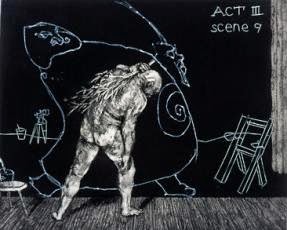
William Kentridge: You are Lying, 2010
As far as I can see, there is no particular or at least very obvious reason why William Kentridge, a South African printmaker and animator, would be famous enough to end up at the Tate and be part of their book collection of contemporary artists. There is nothing terribly novel about his work. However, it may be that it's a timeless quality that speaks to me. While I'm a bit tired of figures, which is such an obvious subject matter - and his are sometimes a bit derivative of Picasso and other artist at the turn of the last century - his figures have a roughness and weight that speak to me. They are solid and corporeal, and imperfect. They aren't always well drawn but it sort of works in pointing to the humanness of the figures. It's the kind of imperfection I've been touting a lot recently! It's a charming relief and contrast to the sleek and over-sanitised work you see a lot (especially when it comes to figures).

Socialist propaganda poster.
"Do you want to -
overcome the flu?
overcome hunger?
eat?
drink?"
Well, the cure for all that is exemplary work with the party, of course.
William Kentridge: Nose 22
An explicit reference to socialism using cyrillic letters
- Kentridge illustrated a Russian opera called "The Nose"

There is a kind of socialist aesthetics - a lot of black, white and red with a great deal of yellowed pages from old books, that gives it all a rather dark air yet is also graphically effective. I'm drawn to the murkiness and graphic quality of socialist imagery of the Soviet era, the red of socialism making no excuses for itself as it pops out of the plain background (presumably cheap to print). Kentridge made images based on Russian operas and has clearly been intrigued by cyrillic lettering too. This is teamed with his love of texture. It reminded me that I've always wanted to pursue this kind of aesthetics but got side tracked. Monochrome work spoke to me already as a child when I read Tove Jansson's Moomin books.


You can see tendencies in this work by me. In fact there are elements of vintage style collaging in Kentridge's work, though printed, many look like collages using old book pages and text written or printed here and there - this seemed mostly the case in work from the '90s.

William Kentridge: Ubu Tells the Truth
I was quite transfixed by the series "Summer Graffiti" shown above, especially the piece at the top. It's a shame that you can't see the subtle red lines of the note book paper. That little red really adds to the images. I was interested in the way he layers the elements so they defy space. In other words, it's flat and dimensional at the same time, and this creates visual interest. I found myself looking at this for a long time. I also like the strong black shape of the blackboards, which adds yet more weight to the whole thing but also provides focal point and a solid contrast to all the thin lines present in the work. The whimsical drawings on them as well as the erotic theme are quite amusing They are images that entertain in a gentle sort of way. Kentridge is clearly a sensual and emotional guy who is comfortable with his sexuality.


Unsurprisingly, Kentridge started out as a pantomime artist. The concept of the world as a theatre and the idea of carnival time is strongly present in his work. There's a tendency towards the surreal. The theatrical aspect of the work also resonate with my own work a great deal. I do nonetheless think this tendency of his has become a tad mannerist that sometimes lacks depth.


I feel that Kentridge is definitely at his best when layering a great deal of texture and lines, these images are very expressive and convey an atmosphere of strangeness. In a couple of large prints his figures were strange and ominous, just barely recognisable as human figures, and that also worked for me. I guess I'm repeating myself but many of his more complex images beg me to look at them over and over again, and that is a rare experience in today's world. Of course the show I saw was very limited so if I have some money one day I will definitely purchase a book of his work. He's impressively prolific and also makes animated films.


My own work:

Vivi-Mari Carpelan 1993 (drawing)

Vivi-Mari Carpelan 1997 (drawing)

Vivi-Mari Carpelan 2013 (collage)
Vivi-Mari Carpelan 2008 (collage)


Vivi-Mari Carpelan 2012 (abstract photographs)


Wednesday, June 4, 2014

MUSIC FOR LIMINAL TIMES IS AVAILABLE AS AN ALBUM WITH COMMENTARY


I decided to make Music for Liminal Times into a concept album already. You can listen to an audio with my commentary here. Oh and if you get all the way to the end, there is a funny surprise there... This is also a bonus track on the album.

The whole album is now on Bandcamp:


Tuesday, May 27, 2014

CROSSING OVER TO THE OTHER SIDE


Ladies and gentlemen... Liminal Tours presents: the ultimate mystery tour.

The concluding part of Music for Liminal Times is about the one massive liminal experience we all have to face sooner or later, that is, death. In this piece, I have drawn upon world-wide perceptions of death. Of course, I can't cover all ground so it was more of a narrative that made sense while referencing certain aspects of death and dying that came to me intuitively.  It contains around 115 clips, most of which have been completely reworked with very simple methods. The point with this project was that it shouldn't cost any money, so I haven't even paid for the software. It's also sometimes better to be creative with simple tools rather than get carried away with fancy ones.

With the risk of sounding pretentious it seemed a bit like channeling the collective consciousness. In other words, it wasn't just about my own perceptions about death. It is about the anticipation of death, the way people talk about death, about the fear of death, the process of death as suggested in art, literature, films and testimonials, as well as a hint at the ambience of the beyond. It has Western as well as Eastern elements in it, of the past as well as modern times. This piece is also a metaphor for the transformative process of psychological death during times of hardship and inner change. 


As always, you can also listen to it on SoundCloud (but the quality is inferior to Bandcamp). The whole playlist is here. Later on, I will publish the whole album too, but Martin may have a look at remastering it first (if necessary).

According to The Tibetan Book of the Dead (Bardo Thödol), what we encounter after death is altogether based on what we expect, and is therefore unreal and illusory. In other words, all the experiences will be in line with the belief systems we had during our life. The reason they believe it's necessary to guide a dying person by chanting and reading from the Bardo Thödol is that the soul (really a kind of subtle mind-stream with karmic imprints) will start to long for a body and therefore seek to reincarnate. The aim is to remind it that what it's experiencing is only a kind of dream state and that the only reality is enlightenment. According to this belief system, the soul can still gain enlightenment after death if it "comes to". At the very least, with some help it can make positive choices while still in this dream state. They also claim that the first thing you experience is emotional impressions of the energetic heart, whereupon a more rational thought process from the head will follow (they are subtle/energetic equivalents to the physical reality). This is of course not unlike the many Western reports of near death experiences, where people report moving through a tunnel towards the light where loved ones reside. My own belief is akin to the Buddhist one but of course in this piece, I have made no definite claims as to what happens once the crossing has been completed. However I can give a clue, which is that I hope this imaginary person has "seen the light"...

In the pieces within this project, I've pointed to the cyclic character of life. Although I'm personally convinced about reincarnation, I didn't feel that I could make this explicit in the piece about death. The end is open to interpretation, because it is a deeply personal choice what one wishes to believe - I can only hope to inspire thoughts and feelings, as it is not for me to tell others what to believe. However, I don't think you need to believe in anything in particular in order to get something out of this piece. I think that the structure of the piece should nonetheless indicate a cyclic theme and the idea of an afterworld. I'm not that interested in what the past has to say about these issues, i.e. I'm not hankering after old beliefs. However I also feel that we cannot ignore the vast experience and thought that has come before us, and it is an integral part of who we are now, as a collective and as individuals. My aim is to bring some of this archetypal material into a contemporary setting. If I was able to produce more of my own sounds, it might all sound different, but this is what I can do with the found sounds that are easy for me to access through the internet.

A Tibetan image of Yama, 
the Lord of Death and the wheel or cycle of life with its many apparitions

Finding an interesting name for this piece proved difficult, as everything seemed pretentious. After all, anything complicated becomes suggestive of something no one knows much about in the first place. I decided upon a simple name anyone can recognise.

Once again I was quite moved by many of the documents that I listened to, as well as the result of my own work. Through this process I have realised just how amazing it is that we have an aural perception, but also that the art of listening isn't simple (especially not in today's world, which scatters the senses). No doubt because I had to listen to so much material with a great deal of focus, did it have the impact it did. Nonetheless I hope that some listeners can capture some of the catharsis I experienced while making this soundscape. Of course I also hope that people would be curious as to what the final voyage could be like, and come on this journey with me. I think there is always a virtue in contemplating mortality with the view of acceptance, as deep down most of us are afraid of dying or losing loved ones. If nothing else, perhaps it can help us appreciate life a bit more. I think it maybe e important to talk about death and the possibility of an afterlife in a serious way because of the way it's being trivialised in modern society. However, the good thing is, it's no longer taboo the way it used to be (which was probably due to superstitions). Personally, I enjoyed tackling such an important and eternal subject matter, but then I'm clearly always at my happiest when I get to draw upon my background in comparative religion and talk about the really dramatic experiences of life.  So that was my take on liminality.

“Life and death are one thread, the same line viewed from different sides.” (Lao Tzu).


Eugene Delacroix: The Barque of Dante.
In Dante's work, the river Achareon is an equivalent to the River Styx in Greek Mythology, 
but has been made a part of hell.
A similar image has, for instance, been adopted in the film "What Dreams May Come".
The idea of crossing with a ferry has been prevalent in popular Western beliefs of the past.
If you didn't have a coin to pay the ferryman with, you wouldn't cross over.
Arnold Böcklin: The Isle of the Dead
So you may ask, what about contemporary visual art about death? I'm in the process of investigating, as I don't know of any offhand. There are many installations that don't lend themselves to being shown as photographs only. This book looks promising, though I'm apprehensive that it deals mostly with artists such as Tracey Emin and Damien Hearst. Perhaps one day we've heard enough of these guys.


The entire playlist can be heard here on SoundCloud:


New statement:

These sound collages explore liminal space. Through a process of deconstruction and reconstruction I have completely reimagined classical music from recordings of the public domain, while also adding other found sounds. At the intersection of music and sound art, these soundscapes exist in a space between old and new, past and present. In this space, the juxtaposition between collective and personal consciousness is at the forefront. Being about liminal times, they reflect a time of transition or "crossing" from one medium to another or one state to another, the archetypal "threshold" of extraordinary times and experiences. Transition and transformation is mostly an inner process with projections in the external world.

These soundscapes are an aural equivalent to the visual collages I make using imagery of the public domain. Creating something entirely new out of something old was the challenge I set myself. The vintage aesthetics from old recordings that is prevalent some of the time enhances the juxtaposition between now and then, and how some things in life simply never change and rather rotate in a cyclic fashion along the spiral of evolution.

Friday, May 16, 2014

WATER - METAPHOR FOR CREATIVE POTENTIAL


A while ago, I tried to tackle the difficult task of setting images to my first piece of music. I didn't want the imagery to compete with the music, so it had to be quite simple. In the end I decided upon some footage I had of waves crashing on the shore in Aberystwyth. To my dismay, the technical quality wasn't quite up to scratch. Granted my camera doesn't take fantastic videos but this was worse than I expected. The reason seems to be that water has complicated nuances and shades, that are forever changing, and the camera simply cannot keep up with this kind of fluid subject matter. I thought I could cover it all up during the processing phase but after a few day's work I was still dissatisfied.

I did a great deal to the footage in cutting out the best pieces and applying subtle effects, and though I can now see that it inspired creative solutions, it was still a disheartening process. I also had to endure terribly long rendering times due to heavy effects, so it took forever to see the results of my changes. Anyhow... I just didn't want to give up and in the end decided to publish my efforts in a smaller format. The round shape was actually Martin's idea (he was desperate to have me finish the excruciating process that I got him involved in too). However, I had had this thought at the back of my mind for some time that I should consider using new shapes for my photographs. It's not easy to decide to lose a lot of your footage, so I just had to be hard on my inclination to keep it all! It is what it is technically speaking - my hands are tied for lack of funds.


The End is a New Beginning from Vivi-Mari Carpelan on Vimeo.


I've been thinking about water a great deal lately, as it's close to my own heart for a whole host of reasons, but is also one of the most powerful yet simple symbols there is. Water is probably the most primordial symbol of creative potential and its manifestation, of the unconscious as well as its expression through emotions and intuition. Many cultures have imagined that life started out as a sea without light, not unlike our existence in the womb. As the eternally recurring cycle of death, rebirth and regeneration is contained in this symbol, the footage and how I have presented it, as well as the music, reflects the idea of change and transition to a new state or level of being.

Themes that have always spoken to me, and that I now find myself resurrecting, are -
creativity and its origin
dualism and how to transcend it through paradoxes
natural and spontaneous versus unnatural and inhibited
the limitlessness of spirit versus the limitations of human life
the nature of the subconscious mind and how it relates to the consciousness
the cycles of existence, eternal recurrence and evolution
and lately also
individual consciousness/unconscious in relation to collective consciousness/unconscious

- all themes to do with the fabric of existence that no doubt interest only a select few, though I think it really should interest everyone! At university, I got bored studying modern philosophy and only found satisfaction when I started to dig into all this kind of stuff.

This project will no doubt be followed by more water-related projects. Please see my previous blog post for more musings about water in the sixth soundscape for Music for Liminal Times.


Thursday, May 15, 2014

CREATIVITY WILL SET YOU FREE!


... or at least it might. It's my belief that creativity is at the very heart of the fabric of our reality, i.e. that it has an ontological status. It's all about being and becoming - and therefore, I also believe that as human beings, creativity is the most fundamental element of our existence. It is what has allowed us to become, i.e. to evolve into increasingly self-aware and complex beings who aren't just in the world, but also add to it in substantial ways. Creativity also exists elsewhere in nature but the lack of self-awareness in other species make their creativity look a bit different and more subtle. 

The ontology of creativity was in fact the subject for my Master's thesis back in '99. In spite of this, I don't suppose I quite grasped the massive implications until just recently. What it really means is that you'll be alright as long as you can keep your creative juices flowing. It is the one thing that will help you through the challenges of life because while you're creative, you're in touch with the very life force itself. Sadly, in our decadent society we lose touch with this energy more often than not, and go about life in a deploringly mechanical way. One has to become conscious of the value of creativity in one's own life and try and keep the flame alive. There are at least two things you can do to support this process. One is to engage in creative activities regularly, and not fall into a rut, and the other is to meditate at least once a day for a minimum of 20 minutes (preferably 30 or 40). Focus on allowing your energies free flow and feel the rise of the energy from the very base of your being and imagine how it connects with your mind. Of course you also need to try and avoid giving into self-doubts and the need to please other people, which obstructs the natural creative flow and takes away from your feelings of accomplishment (see previous blog entry).

My latest sound collage references Mihaly Csikszentmihalyi's famous theory about creativity and flow and imagines what the creative process might sound like. The experience of creative flow is a peak experience and therefore, I would argue, also liminal in nature (see previous posts). The creative process in itself is, however forever ongoing unless obstructed. This piece contains many references to space and water, two powerful symbols of creativity. One suggests that it can be an otherworldly experience that has something in common with flying, and the other that it requires a connection with the intuitive and emotional world of the subconscious mind.


You can also hear it here on SoundCloud, but the version above is slightly improved.

These two polarities are therefore metaphorical of two areas of our inner selves, the lower and higher regions of the psyche or the two ends of the spectrum of consciousness. To make it easier to imagine, consider this image. In Hinduism, there are two god figures, Shakti and Shiva, that represent these energies. Shakti (earthy, watery) lies within the unconscious sphere as raw, physical energy required for all forms of conception as well as the very potential out of which creative manifestations arise, and Shiva (ethereal) is pure consciousness, i.e. the spiritual aspect that manifests as creative inspiration. They are said to be in a dance-like play with each other while giving rise to our personal and collective reality. You could say that these forces function as theses - antitheses = synthesis. In a sense they represent a mentality of generosity in a personal as well as impersonal way. I believe this is how our reality arises all the time, without cessation.


If we live naturally we will automatically be creative (as artists we just happen to make art but it could be any other pursuit). It's really a wonderful thing that should be celebrated. Our subconscious mind is an immense storehouse of ideas and I believe we must let it come out the way it wants to come out, and not question it. We will then express who we truly are. I find it helps a bit to try and believe that we all have great creative potential outside of our normal consciousness.

The soundscape wasn't easy to construct, as it was quite complicated. I didn't plan what to put in it but advanced in an intuitive way, gradually getting the bits together. I listen for all sorts of sounds that make sense to me, based on some general idea about the atmosphere and message. I thought the piece was going to be more about the state of flow but in actual fact it became more about the process. Towards the very end I had to ask Martin what he thought of a couple of issues. I took his suggestions to heart but all the changes are my own. All the found sounds need to be stringed together in a way that makes sense. Sure it will sound like a collage, because it is one, but it  also has to make a sense in a musical way. The snippets of melody (a few of which I constructed from entirely from scratch, i.e. from single notes) are suggestive of the way the research phase of the creative process, when various ideas present themselves and beg to be tested. There are also times when it all feels difficult and one might even feel stuck. Once a sense of flow sets in, it's like flowing with a stream but also diving deep into the bubbly underwater world of the subconscious mind. The tinkly sounds represent excited, creative energy. The piece starts with some space sounds from the Earth's atmosphere and ends with it too, because we always have return to Earth after our adventures in other spaces (don't we?).

Once the piece was finished, ironically, I just couldn't think of an evocative title - everything seemed banal. Referencing the famous creativity researcher's Mihaly Csikszentmihaly's amazing Hungarian name (/ˈmiːhaɪ ˌtʃiːksɛntməˈhaɪ.iː/ mee-hy cheek-sent-mə-hy-ee) in the title was in fact Martin's idea - rather tongue-in-cheek. He also suggested "chill out mix" which is quite funny. In the end I settled for a simpler title that suggests that the only way we can be truly happy within ourselves is by being in touch with the creative spark.

In this TED talk, Mihaly Csikszentmihalyi asks, "What makes a life worth living?" Noting that money cannot make us happy, he looks to those who find pleasure and lasting satisfaction in activities that bring about a state of "flow." (from the TED website).


Wednesday, May 7, 2014

THE TRAP OF TRYING TO PLEASE "ALL THOSE OTHER PEOPLE"

Photograph by Vivi-Mari Carpelan
Most of the time I have pretty extreme doubts about my art, and it hampers me a lot. What I try and do artistically is of such great importance to me, I just cannot take it lightly. Because of chronic illness it's the only thing I'm able to do in order to feel accomplished. It is in this respect my day job (I spend an average of five hours a day on creating,  still I feel it's taking way too long to "get anywhere"). I also feel very driven to make a difference. Some money out of it all would of course be welcome, but I can just barely survive without it, and so don't make it into a priority. Life is stressful enough as it is.

However, I don't have a degree in fine arts and my line of thoughts and feelings run counter to those of the average art world. The blankness, rejection and general lack of encouragement is deadening to say the least. There was a time when I was successful with the general public, but times have changed. Today, there are more artists who compete for attention. My own art has changed and may not be as easy to take in as it was twenty years ago. People's habits in regards to consumption have changed. The internet has changed the way we view art because there's so much of it readily at hand, and information about exhibitions is also easily available. There's simply too much choice, people get overwhelmed. The collective consciousness is even more ridden with urgent challenges, and we are made increasingly aware of various forms of threat through an increasing variety of sources - art is seldom seen as a necessity in times of great upheaval. However, it's also in times of great upheaval that great art is often made, but the artist's contemporaries will no doubt find it difficult to distinguish greatness from the ordinary. It may take some perspective to perceive that which is truly meaningful and significant to the overall collective mind, and it's perfectly possible that no one will.

When I arrived in the UK and took up art again I soon realised just how competitive the art world has become. All bigger open exhibitions are connected to awards, and if you don't win them you're not considered a good artist. However, you probably won't win any awards unless you have a degree in fine arts. As an artist, you end up depending more and more on other people's opinion and criteria, and it can affect the way you make art. This will result in more mediocre art. What I see is that a lot of contemporary artists are not intuitive and true to their souls, but people pleasing and calculating. That's why so much contemporary art is so crap. For instance, everyone knows that art with a social message is more highly regarded than say expressive emotionalism, so young artists try and bend their minds towards a strategy of socially engaged conceptualism that satisfies the art world. Art with a social message is only good art if it comes from a deep place. But of course commercial art that is purely decorative is just as bad. Most people (i.e. the average person) are complying with rules and regulations, thus supplying more mediocre art to a world that is replete with blandness.

The lack of support and encouragement threatens to kill my spirit. I may not be making great art, and it certainly isn't always good... However, you would think that people had a heart and remembered the moral of smiling at least once a day at the person at the cashpoint or a random person at the bus stop. Make their day! Well, artists also need a "smile" to keep going. Be a good human being by being generous and kind to those who are struggling to do what they are destined to do, regardless whether they are making a huge contribution to society or not. Support will help them get better at what they are doing, and it's potentially for other people's benefit too. No one is an island.

If I ceased trying to get my art out there to the attention of the general public and art authorities, and focused on being creative on my own terms instead, I might get some kind of peace of mind. However it would also damage my desire to communicate and certainly ruin every chance of ever "making it" while still alive. Seriously - I'm in two minds about this. I'm driven to communicate so withdrawal doesn't seem to be the answer. No one likes rejection and some of us are more prone to suffering from it. It can hamper you so badly, that you just give up. You don't know for sure if you're making good art or not because you're not getting much validation, and it could mean the end of a really promising path (I rather say "path" than career). After all, a lot of writers and artists have struggled for quite a bit before making it. Often they had very little support until they were suddenly discovered by an authority who resonated with their work. 

There was a recent TED talk with Elizabeth Gilbert, the author of "Eat, Pray, Love" who struggled with rejection for years until she made it. However, in this case we seem to be talking about stuff that's fairly commercial - I don't know about the book, but I saw the movie and it's pretty cheesy. I know that in the end it doesn't matter what you do as long as you do it creatively and with integrity. It really doesn't matter what you do, because there should be room for everyone in our world (that's what true diversity should be all about). However, if you're not looking for commercial success you may end up lacking in some drive. After all, who are you supposed to communicate with? What does success look like to you? It can be hard to imagine if you remove the rather straightforward commercial aspect, and so you may end up feeling pretty scatty and unfocused. You might have to think consciously about how you can bring yourself back to your own inner centre. Even when you are doing what you love, it's never an easy ride and a lot of the work you have to do is tedious and uninspiring. It's a little bit of inspiration and flow, and a lot of hard work. To remain in touch with your soul throughout all this is definitely not easy. 

Every once and again I cry for a day and then pick up again when I got the sadness and frustration out of my system. I lick my wounds and consider that people might just be too stupid to get me (I know you shouldn't, but... I'm only human). I think of ways in which I can minimise exposure to disappointments, including trying too hard to get noticed. Trying too hard to gain attention is not a natural and fluent way of existing. I remind myself of the Taoist ideas about going with the flow along the lines of the least resistance. Take the watercourse way. Nowadays I also meditate at least once a day (three times would be better). Though it's sometimes a fruitless pursuit, it seems to be the only way in our chaotic world that one can regain some inner balance and poise. My husband then reminds me that my job is to make art for the future. It may not please society we know today, but it just might point the way in some way... I guess what I really want is to help people reflect upon the great pathologies within the collective psyche, and trying to be different is to go against my deepest concern, and it's a spiritual one which I'm well aware doesn't sit well in postmodernist society. I'm neither particularly clever nor geeky. Perhaps one day it will be appreciated in spite of all its shortcomings. 

This blog post was inspired by another one from "For the Creators".


Tuesday, April 29, 2014

THE TAO OF WAR AND PEACE IN MY LATEST SOUND COLLAGE


My latest piece "War and Peace is a State of Mind" is about the eternal recurrence of conflict and harmony, and how the murky recesses of the individual and collective consciousness reflect the state of the world. It was a complicated one and the research as well as the creative process of putting all the bits together inspired some deep-felt emotions and frequent bouts of tears. It was interesting to listen to historical documents about the Second World War in a very focused way - when you see these things on TV they just pass by so quickly, and don't usually cause a deeper emotional connection with the way things really were back then. The rhetoric used varies a great deal, it's sometimes aggressive warmongering, sometimes triumphant propaganda, sometimes woeful but determined statements - and then there's the neutral voice too, in order to complete the spectrum. The explosion of the atom bomb has a profound effect on me. I decided to stick to parts of WW II and the Cold War because of the wealth of documents that are now part of our collective consciousness, and also because introducing more modern wars would simply have been overwhelming with confusing results. I hope some of what I felt will come through to the listeners.

In case you wonder, the theme in the beginning is not from an ice cream van, but a theme (the Swedish Rapsodhy) that is said to have been used as the interval signal for a German language numbers station during the Cold War. The idea of weird codes being transmitted through the air is somehow alluring and creepy, but also quite a strong metaphor for the murky world of the collective consciousness (or even unconsciousness).


In my last post, I explained what liminal means and suggested that war is usually seen as a liminal experience, i.e. "out of the ordinary". I was interested in exploring this assumption further, not least as it was an excuse to equate the external event with ongoings in the human psyche. I realise that a lot of people will have no idea what I'm talking about when I bring in some Taoist philosophy, but I will attempt to explain myself nonetheless. My sleep, or lack thereof, is a disaster and I'm finding that a possible cause could be an neuroinflammation in the brain, that is an over activation of microglia... I'm very worried about my upcoming sleep study and whether there is any help to be had. I have been able to escape my worries by drowning myself in work when I can focus, as this sound project has been quite exciting to me. However, thinking is very hard for me these days and my inability to sleep naturally and my increasingly adverse reaction to medication doesn't help. I still hope I can make some kind of sense.

According to a Taoist way of looking at reality, polarities are fundamentally interconnected and not in conflict with each other - the conflict lies within the human mind. Life has a cyclical quality, as polarities (yin and yang) shift from one to another. One can't exist without the other. War can only exist as a counterpart to peace, and vice versa. 

We think of war as liminal, i.e. “out of the ordinary”, but this is not quite true if we look at war and conflict in its broadest sense (and I think it's really only liminal in some ways were there is real change involved). Conflict is as frequent as the lack of it. This might be easier to see if in your mind, you exchange "conflict" and "war" with other forms of disorder and chaos. Life is a wave movement that alternates various forms of chaos with forms of order and stability (there is a tipping point where everything is in good balance, but it doesn't last as nature has to take its course). The way of nature is inescapable, it's our attitude towards the facts of life that we should worry about more.

To humans, war is normally terrifying but in the long run, a lack of action can also get tedious. People also get complacent when everything is a bit "too easy". This is as much an external reality, as an internal one. I think it's really important to remember that one mirrors the other. A dissatisfied and agitated mind will cause havoc in real life, but warmongering can also arouse other people's secret aggressions and make people lose their inner control. To change the world you do have to address the human psyche first. The point, however is, that you can't do that by fighting and repressing your urges. That's violence against the self, which in ironically just perpetuates the idea of violence. The more you resist something the more it will keep coming back. That's why resisting war isn't the answer either. In fact, our "fight and flight" mechanism isn't serving us very well anymore - more and more people are succumbing to stress related diseases. We are luckily evolving, and are thus able to find new and creative ways of dealing with perceived threat. We need to rethink our propensity for stressful situations in which we are hunting or being hunted. How can we lead our lives in a more emotionally mature and less simplistic way? That is surely our future!

However, the point I really want to make is that by resisting conflict while advocating peace in a warrior like way we are shooting ourselves in the leg. History already shows that holding onto peace (or status quo as it often means in practice) too forcefully will lead to all manners of suppression and ultimately civil unrest. Even "fighting for peace" is a warrior's stand, and perhaps humanity needs to reinvent its warriors (in fact some of them are now "diplomats"). 

To realise the nature of this semantic tension in our minds is surely a way of dealing with the urge to exert aggression towards one another. If you postulate that polarities are irrevocably interlinked like two sides of a coin, then by reinventing the idea we have about conflict and how to solve it through war, we automatically reinvent our idea of peace, and vice versa. That to me is evolution, but it's up to us how quickly we are willing to allow for change.

The way the world runs the wars at present is patriarchal (note the lack of women in the piece, as I simply couldn't find any other than ones in numbers stations), but thanks to evolution, expressions of disagreement and power eventually change over time. In the end, the concept "war and peace" is no doubt less about what it represents to us in our minds than how we may reinvent these concepts and seek less destructive ways of dealing with challenges within ourselves and in relation to the rest of the world.

I have written some more about eternal recurrence in this blog post.

Tuesday, April 15, 2014

MORE EXPERIMENTAL MUSIC FOR "MUSIC FOR LIMINAL TIMES"

Quality downloads of my music from Bandcamp

Having branched out, I now realise how each medium lends itself to quite specific ways of expression, and they truly are not interchangeable. I decided to continue experimenting with found sounds and the subject matter that came to me was times of change and transition. It has been quite fascinating to see how feel different about this medium - I feel that I can express psychological realities in a way that I can't quite do with other media. Sound has always been quite an emotional affair to me and I have been curious about alternative music all my adult life, so it comes as no surprise that I seem to be more emotionally expressive this way. Perhaps that's just my personal impression based on novelty value, however it has still been quite satisfying to me. 

I have realised that I really want to champion a greater attention to emotional intelligence, as I feel it has gotten somewhat lost in this mechanical age. It is easy to forget just how multidimensional we are when we go about our day in a typically mindless way. I know many people find this kind of music very difficult and maybe even pointless, but it does require some attention and mindfulness. It's not supposed to be easy, yet I would hope that when given the appropriate attention it would trigger some sense of recognition and connection with the psyche. It's not meant to be "just entertainment", nor is it meant to be so difficult no one can stand listening to it. Why this music is at the intersection of music and sound art is in my opinion because it has a specific concept and attempts to express ideas in a reasonably complex way. One can argue this line but it's fairly clear to me. This music requires reflection, not just mindless consumption. My mom was quite taken by it, and said it sounded just like me, and that it gave her imagery that she remembers from my visual artwork since time immemorial. This musical pursuit really reflects my life long interest in the deeper layers of our psyche - in fact one of the strands of comparative religion that I was focusing on at University was the psychology of religion. It's all making sense to me now...

I have created two new pieces and decided to pursue this project until I have a complete album. I call this endeavour "Music for Liminal Times". The word liminal is to me an intriguing and beautiful word. I realise not everyone has come across it but hey, then it's about time, eh? Liminal is originally an anthropological term that denotes times of transition and change. It's a time that is out of the ordinary. It can be a rite of passage, it can be times of war, it can be crazy carnival time, it can be times of relocation, or times of inner change. These times are archetypal thresholds, usually marked by disorder and chaos until a new order ensues. All of these situations are interesting from a psychological point of view because they help us evolve, on a personal level as well as on the level of collective consciousness. I find that I am really quite fascinated with the way collective consciousness interacts with the individual consciousness, often in a compelling and quite distressing way. To withstand this influence and retain personal integrity is difficult. However, I believe that awareness of this and how we transit from one stage or level to another is quite important to a more fluid experience of life.


In anthropology, liminality (from the Latin word līmen, meaning "a threshold", is the quality of ambiguity or disorientation that occurs in the middle stage of rituals, when participants no longer hold their pre-ritual status but have not yet begun the transition to the status they will hold when the ritual is complete. During a ritual's liminal stage, participants "stand at the threshold" between their previous way of structuring their identity, time, or community, and a new way, which the ritual establishes. /.../ The dissolution of order during liminality creates a fluid, malleable situation that enables new institutions and customs to become established. (From Wikipedia)

The two new pieces are...


Please note!! If SoundCloud isn't working, go to Bandcamp instead.

The theme for the first one was suggested by old recordings done on an Edison Sound Cylinder back in 1904. The music sounded quite odd and was fun to work with. The quality of the singing was so terrible at times that it made me think of how desperate people enter singing competitions in order to be famous. Fame is another very futile and transient experience that is surely quite nice while it lasts, but as we all know is also of very relative value and a very exclusive one at that. It has little to do with real (ordinary) life, yet even I secretly dream of it..!

The theme for the other piece was one I already had in mind while I was looking for material, as I mean to make a film with my abstract photography ("Traces"). I have already discussed the possibility of showing this film during a themed exhibition at a nearby gallery ("Maesmawr") next year - the owner is planning to show several films on the theme "Journey".  Being in transit - transitioning from a to b - is of course a liminal experience. This time, I was inspired by my own efforts to meditate and thus try and rebalance my self. As most people know, when you do you become mindful of many inner events and psychological issues, and that's what this piece is mainly about. I did find it difficult to make it long enough, without it becoming cliched and boring meditation music. It took me quite a while to figure out how to create harmonious depth to the latter part. 

I hope it's not too hard to detect my sense of irony and subtle humour in these pieces. After all, if we take life too seriously we will only become depressed and even suicidal. 

The first piece took me only two days to create, but after that I had a lot of flawed waveforms to fix (that's a whole new ball game, phew!). The preparations for the second piece took a couple of days (that is, collecting the sounds of the public domain as my rule of thumb is that it must be free, as difficult as it is to find such sounds), then the actual creation took about three - four days. It means I now have more method and experience than when I did the first pieces, but I'm working with very basic and quite cumbersome free software (Audacity). 

The making of this music is a process of complete deconstruction and reconstruction, during which I reimagine classical music of the past - one may in fact question whether classical music exists at all today. To this mix, I various other elements of my own liking.

You might like to see how Max Richter has reimagined Vivaldi, and also a project in which he refers to the past through the spoken word, Memory House.

Monday, March 17, 2014

ON A QUEST FOR MORE SUBJECTIVITY, HEART, SOUL, SPONTANEITY AND REAL ART!!

"Junk Mail", photograph by Vivi-Mari Carpelan.
This is a comment, I hope I don't need to explain myself.

As we all know, over the past 250 years science has taken precedence over heart and soul. For every invisible phenomenon, there is supposedly a perfect rational and visible explanation, and they presumably match each other without fail. It is not about correlation, it's about blatant reductionism. The arts have followed suit because what is considered superior to the artist's inner life is an artist's ability to state an objective point of view about the world. Spiritual concerns are just passé! But how does that help us recover our fragmented selves? Surely art should support self-development and the development of a more humane society? I find it immensely disturbing that subjective truth is so down market at this point, and therefore I'm on a mission to help bring it back into people's consciousness... to reinstate a balance between subjective and objective... a bit of a task, eh! This article has come about from discussions with my husband.

There is so much art out there to browse, so one must be careful about generalising the art world too much. However, I do see a trend which supports the idea that an artist must start with a clear concept that they then create the art to fit the concept. People who wish to be artists are desperately trying to think of more and more "clever ideas", because that's what art authorities seem to expect to see. For instance, if you apply for a grant from the Arts Council, you usually have to have a very precise idea of the kind of project you wish to pursue, and then make damn sure you deliver it too. Unfortunately, as Martin pointed out, if you make up the art to fit your concept, you're actually only illustrating an idea. And that's often just bad philosophy anyway.

Where is the true creative spark? Coming up with ideas is creative, but if it's not taken further and moulded into something a great deal more comprehensive and profound, then there really is very little creativity involved in the process. I'd almost go as far as to say that if a wannabe artist isn't able to let their soul sing in order to create something surprising and even wondrous in some ways, then they aren't worthy of being called an artist. It's amazing to watch one's own subconscious mind organise elements into an unexpectedly meaningful whole. It's in essence a spontaneous and life affirming process, not a dry calculated one (the calculation only comes in sometimes as a mere supportive tool). You start out with "some kind of idea', a hazy concept, and then let the alchemy take over and basically just see what happens. I'm so sick of seeing superficial, calculated cleverness in the arts... everything has been dumbed down to the lowest common denominator. What sometimes may appear as difficult art is often just very bland and superficial. Having the guts to trust your instinct and see through the veil of snobbishness isn't easy for everyone though, because we have been told it's good by presumably trustworthy authorities. 

The situation is so skewed. We saw one of the shows in the lovely BBC series "What do Artists Do All Day?" about the performance artist Marvin Gaye Chetwynd. She has tons of energy, which could account for the fact that people are so taken in by her that they give her lots of money and freedom to do what she wants. She engages a lot of people in her performances, too. But it's so badly made and so badly performed! It all really looks like a crappy school play with replicas from scifi movies, and all she's doing is just farting about a lot (as Martin put it) and then inventing some political story to cover up her dodgy tracks. The boulders made of paper the performers were carrying about that were supposed to symbolise debts... oh god, the banality and poverty of expression! Perhaps through this art you're supposed to discover your inner child? I have to say there was nothing I enjoyed more when I got out of school than burying my child self for good somewhere in very deep and dark forest, and no I don't want it back! Because Chetwynd's somehow gained attention (she was nominated for the Turner Price in 2012 for some rather sad looking performance that was supposedly about democracy), she was being put on show in the Nottingham Contemporary art museum. I feel that it's another case of the emperor's new clothes - because someone has put her there, people believe that she's worth appreciating. She says something to the effect that she doesn't believe that you need to know anything about art in order to understand what she's doing... well... it sure doesn't take much to realise what she is doing, or not doing... I'm sorry, but one thing it isn't, is art.


The other day someone passed on a rather innocent comment on the internet about how real art doesn't require any education, anyone can intuitively enjoy art and culture because that's what it's for... or something like that, I forget the exact phrasing. Of course lots of people would ascribe to this, and happily enjoy whatever art they feel drawn to, and that's fine. Yet... it would be an ideal world where everyone would just follow their intuition, but this is not the world we live in and very few nowadays have a clarity of vision that allows them to see right through the art - and I mean all art... There's a difference between enjoying what you feel attracted to (which is fine, but a limited way of experiencing life) and seeing art work in general for what they really are. Art is more than just Mona Lisa and Sunflowers, and by the way Picasso and Matisse are over-rated. 

The point is, education is valuable in today's world. I just said people should question authorities. Yes, but I also resent having it suggested to me that I can't possibly be less knowledgeable about art than an office clerk. The worst is, it's uneducated and ignorant people who would say such a thing. I thought about it and came to the conclusion that I wasn't reacting so vehemently to the statement above because I necessarily want to be seen as an authority (which is nice but not all-important). I was reacting because these days, laypeople don't seem to have any respect for expertise - everything has to be dumbed down so that the simplest of minds can understand what is going on. Everyone is subliminally told what to think but they often start believing they came up with it themselves. It's a great paradox, that people ingest so many relative "truths" without discernment that they find difficult to question, yet also want to be self-sufficient and rebellious when someone comes along with some expertise (a sign of the good old narcissistic individualism I expect). I don't blame them a lot of the time because many people with expertise aren't serving them well, and perhaps it's also a sign that attitudes are changing. Yet there is also the possibility that the internet gives people the illusion they can be an expert on pretty much anything there is, because they can browse so many pages... but someone put it there in the first place and a lot of information is superficial and biased in insidious ways. If you're not trained in critical research, this information could be difficult to handle.

Interestingly, almost anyone can get into a university these days, too, so it's no longer just for the intellectual elite. What will happen to the standard of teaching? Art authorities, who themselves have an education behind them, do expect artists to have one too. In this case it's very often about looking less at the actual art than the artist's CV... that's because in the end, it's still the objective view point, the lists, that mean the most (have you noticed how everything is always made into lists? Five reasons you're not a good artist!). Basically, it's all a terrible mess! That's because what is lacking is a clear distinction between the experience of deep feelings and intuition, and a plain rational evaluation of a phenomenon in the world.  People don't see these faculties for what they are, they tend towards one or the other without discernment (or awareness, even). The faculties are therefore usually in conflict instead of complementing each other the way they are meant to. Feelings and intuitions are immensely useful in helping us make real sense of the world and its objects from our subjective standpoint, whereas objective rational analysis is hardly any better than a computer's way of processing (though in fact slower!). It so often doesn't arrive at the correct answers, either - rationality usually comes from a very prejudiced place, the home of all our belief systems and other mental constructs. It's that thing about right and left brain, heart and mind, and so on. Collective consciousness is undoubtedly now on the level of thoughts (rational, cognitive processing), so it's natural that this kind of mental processing would seem very important to the majority, but it's a terribly insular level and really needs to start moving towards something a bit more lifelike. The world has become stifled and robotic, and lost much of the soul and spirit that makes life worthwhile in the first place. It's but one of the signs of a very decadent society.

However, the years of studying art and art history as well as experiencing the art world first hand that I have behind me do account for something. For instance, my education at a real University as well as the university of life allows me not to confuse "liking" with "understanding". If I feel uneasy and don't understand a piece of art, I usually find in conversation with Martin that it really was as meaningless as it appeared at first. It gives me confidence to pass a value judgment on art work. And though there is no objective guarantee that I'm right about what I think and feel and could in fact be a terrible culture snob, that expertise should still have intrinsic value. I was also upset because I feel that as soon as I make art that is a bit difficult to understand, people shy away. People seem to expect everything to be really easy and palatable, i.e. dumbed down. I don't want to be too harsh because I also see that people are tired, bogged down and in need of hopefulness. There's only so much people can take in. However... it's easy to escape into a world of pretty pictures and cute animals and twee spirituality. Suddenly everyone is an expert and able to say "this is good art" simply because it's pleasing to them. Even integral art can offend a serious artist / real imperfect human because of being so glossy, banal, often anti-feminist, and anything but all-encompassing (i.e. truly integral and integrated) like this stuff by a Finnish guy. I saw a visionary artist calling themselves a "conscious artist" today, no doubt meaning they have their eyes wide open and are spiritually receptive... however I believe that art has to be largely subconscious in order to be meaningful (for instance, creative solutions often come to us after sleep), and therefore that kind of statement to me isn't really analytical enough! Intellectual ability is a good thing too, just knowing its real place in the grand scheme of things is important.

Not everyone sees any point in dwelling on difficult issues. But I want to inject, that if people stop sharing serious issues with each other, nothing will ever change for the better. You have to take the bull by the horns! This is everyone's responsibility, is it not?