|
| "Entity" - photograph by Vivi-Mari Carpelan from the series "Traces" See description below |
Perhaps there is synchronicity after all, because my general depression since a number of weeks back has been coupled with some art related rejections that leave me feeling that I should really either give up or up the game by completely reinventing myself - I can tell you this is a very serious question for me at the moment. How likely is it that you can reinvent yourself..? Of course you can probably learn to deal with rejections in some way, knowing just how many artists are struggling for attention. But when the rejection comes from what you thought of a peer group, it feels doubly hard.
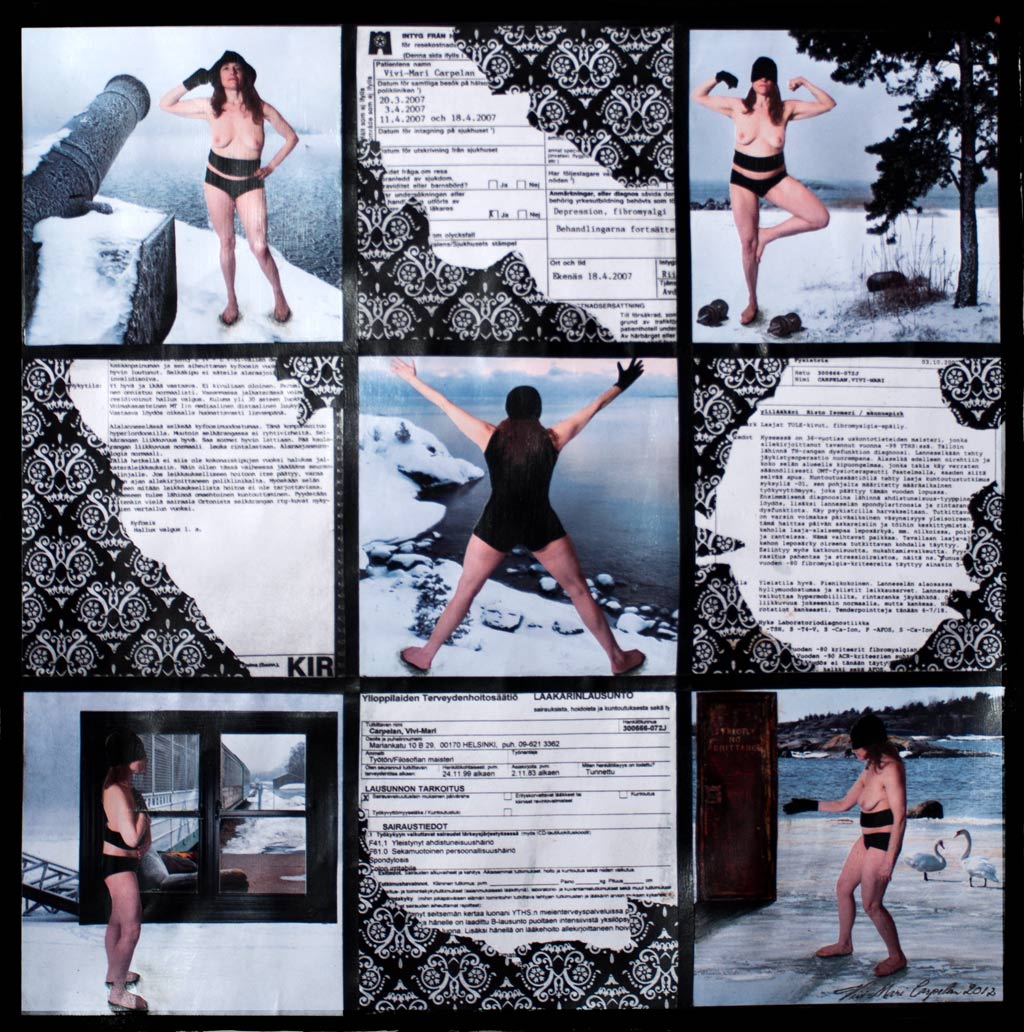
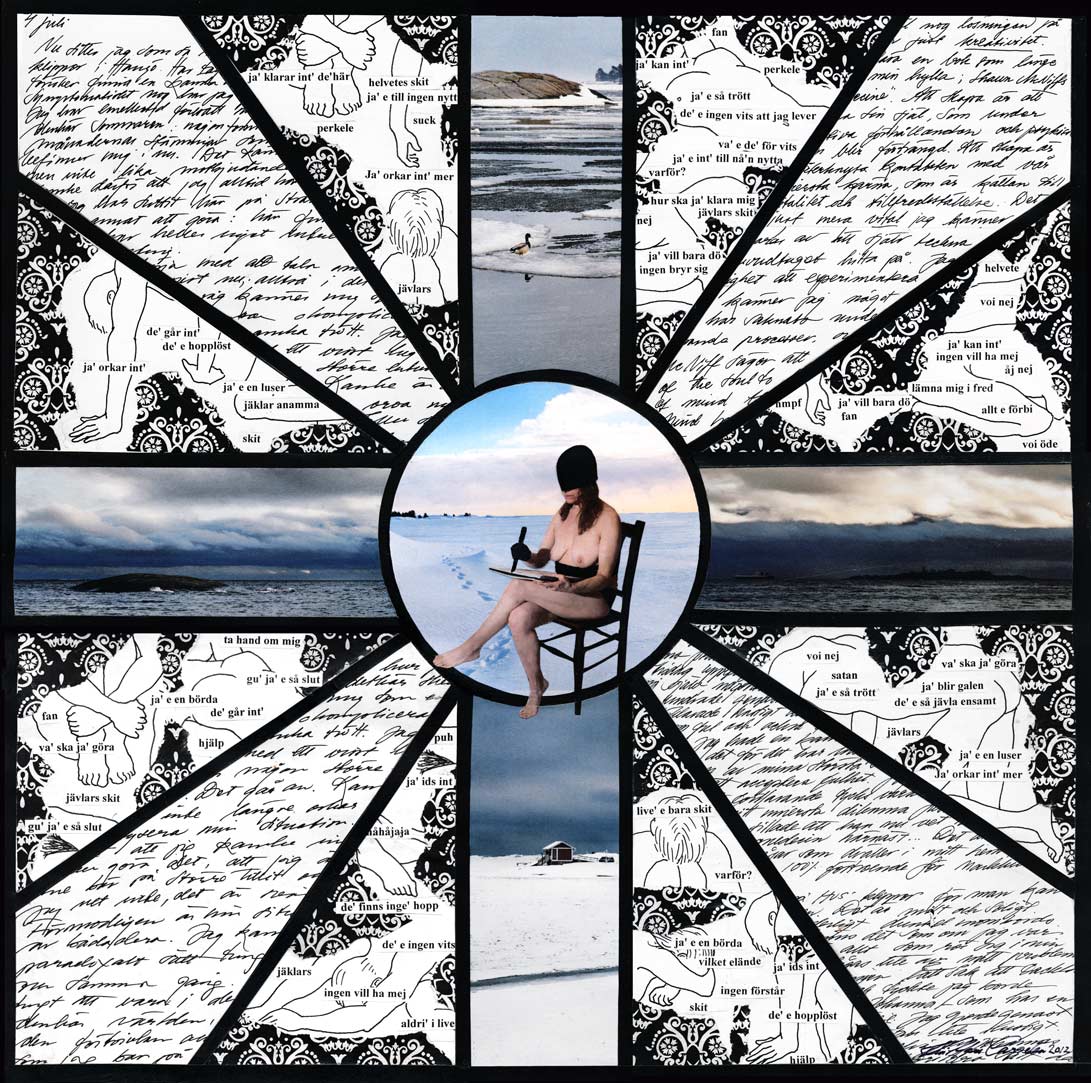
Having worked for so long on Project X and Visible/Invisible, I really did presumptuously expect to get into this year's Shape Open on the theme (In)Visible. (Did they nick my title?!). It's about the repercussions of "coming out" as disabled, and stuff like that. The brief should have matched my project quite well. Neither my latest collage nor my film "Tides" that was part of the Visible/Invisible trilogy made it in. I thought, well if they don't appreciate what I've tried to express, then who will?
Though I realise the judges are biased in various ways and that my feelings are tied to the fact that I put so much effort into my project, exhausting myself in the process with a desperate need to communicate a message, I also do wonder about Shape's policy to invite non-disabled artists to participate. To me this is making the point that Shape is primarily working for the cause of disability, not for disabled artists and helping them get their work out into the world. The curator has even stated that Shape is about the art, not the artists. I realise it's all very political and governed by the necessity for PR, but this policy is making disabled artists forced to compete with abled bodied artists. I thought the point with the disability arts was to provide opportunities for those artists who find it difficult to enter the normal, competitive art world. Perhaps I'm completely wrong, but... it does seem to me that organisations such as Shape are in fact indirectly trying to encourage disabled artists to become as much like everybody else as possible, while attempting to show to the world that disabled artists are not really different than anybody else in spite of looking or behaving differently. To me it seems similar to feminism, which in its heyday was more about helping women to be like men than giving women the right to be themselves. It feels like it's potentially the kind of pressure to conform that we already feel from society at large.
Though I realise the judges are biased in various ways and that my feelings are tied to the fact that I put so much effort into my project, exhausting myself in the process with a desperate need to communicate a message, I also do wonder about Shape's policy to invite non-disabled artists to participate. To me this is making the point that Shape is primarily working for the cause of disability, not for disabled artists and helping them get their work out into the world. The curator has even stated that Shape is about the art, not the artists. I realise it's all very political and governed by the necessity for PR, but this policy is making disabled artists forced to compete with abled bodied artists. I thought the point with the disability arts was to provide opportunities for those artists who find it difficult to enter the normal, competitive art world. Perhaps I'm completely wrong, but... it does seem to me that organisations such as Shape are in fact indirectly trying to encourage disabled artists to become as much like everybody else as possible, while attempting to show to the world that disabled artists are not really different than anybody else in spite of looking or behaving differently. To me it seems similar to feminism, which in its heyday was more about helping women to be like men than giving women the right to be themselves. It feels like it's potentially the kind of pressure to conform that we already feel from society at large.
It's complicated because it also seems that there's this thing that disability should be celebrated (as recently pointed out to me). I'm assuming that's because difference is considered a value in itself, regardless what the difference is. This could indicate yet another symptom of flatland, where any kind of difference regardless whether it's to do with sexual orientation, gender, skin colour, learning ability or mobility issues should be considered equal in the sense that they are as valid as the norms they are being put up against. Of course in a sense they are, but that's just part of the truth - minority issues are more different to one another than they are similar. A more important fact is that disability is severely limiting to the ability to function within the framework of society, and in this respect it differs greatly from other minority issues. The more disabled you are, the less you can function. Because you can't function, you can't work or participate in any of the grand schemes for the employment of disabled artists (employment, residencies, commissions etc.). The new different soon becomes the same.
You need help, and you need for others to realise just how much you need help. You don't need to be told that it's fine to be different. It isn't fine to be ill. It isn't a thing of joy that you should have to feel obliged to celebrate. You need to feel that it's alright to be who you are. What you need is for society (and that includes the art world) to value your input for what it is, no matter how small it is. This also means that there should be more opportunities for people like us, not less - Shape being open to non-disabled artists is no doubt eliminating quite a few disabled artist from the opportunity of showing work.
When Will Self has been going out with an appeal on BBC to support disabled artists through Shape, I'm thinking this publicity is also attracting a lot of go-getters who think it actually gives them street creed to be in an exhibition like Shape Open. I may be very unfair but I can't help this has crossed my mind. I have asked how many this year were non-disabled but have received no answer. It also makes me sad to hear publicly that Shape is all about supporting disabled artists when this a half-truth. Perhaps they are afraid that disabled artists will drag the standard down to a level of amateur art, when they are trying to validate disability at all costs (what disabled artists create is just as good, blahblah...). Accessibility is not all about wheel chair access and difference is not just about a strange body shape, though these are important view points as well. There is a world of difference between someone who is slightly visually impaired and someone who is completely blind. Imperfection needs to be embraced in this over-sanitised world.
If disability arts organisations are trying to raise their profile by selecting only work that conform with the general consensus regarding the kind of art that should be considered "real" contemporary art, they are basically saying that disabled artists can do it just as well as able bodied artists. While this would be reasonable within the framework of an exhibition only aimed at disabled artists (because it's based on the idea of what constitutes good art), I don't think it's alright when a whole bunch of able bodied artists are entering the game. That's because you are then eliminating the important fact that a disability will almost invariably inform the art made by a disabled artist. It would do this through content or mode of execution. People who are seriously disabled will quite likely be limited in their expression. Of course limitations can encourage creativity, so this is not always a bad thing per se. However, there are many things many of us really can't do which simply limits our choices and may influence our ability to conform to the expectations of the art world.
I mean - through the process I've been going through I've started to imagine work I could do that would conform a lot more to the expectations of contemporary art, but I can't imagine how I would execute them. I can just barely make what I make now. I do not have the physical, mental and financial means to start looking for companies that can execute my wishes regarding bigger work and installations, and then store the work, and then get it out to exhibitions somehow. That's just for starters. I definitely can't do performances, which seems to be all the rage. I'm also stuck with certain basic software, with certain skills that I take long to develop on my own because I can't go on courses. I'm stuck with physical discomfort while I work which can be hard to resolve. I'm stuck with the inability to do anything finicky with my hands. I'm stuck with the kind of tiredness that can make it very hard to feel creative and focused enough to make something spontaneous and beautifully instinctive. I can only work for about four hours per day, and that's starting around 2 pm when I can finally get going. This is not to mention how hard it can be to formulate an artist statement on some days. The imperfections I've talked about in my work are inherent in the work itself.
Having said that, resolving the insomnia would be a good place to start making different work. Having now pondered this for a long time, at least I know in which direction I might want to try and go. At least I'm not completely cut off from artistic currents because of the internet and my artistic husband who talks to me and takes me places, so there is scope for change. For one, I'm done with trying to speak about problems no one wants to hear about, because being rejected for my messages is even harder than being rejected for my actual work. And perhaps this would also free me up to do more instinctive work, who knows.
Having said that, resolving the insomnia would be a good place to start making different work. Having now pondered this for a long time, at least I know in which direction I might want to try and go. At least I'm not completely cut off from artistic currents because of the internet and my artistic husband who talks to me and takes me places, so there is scope for change. For one, I'm done with trying to speak about problems no one wants to hear about, because being rejected for my messages is even harder than being rejected for my actual work. And perhaps this would also free me up to do more instinctive work, who knows.
I think that judging disabled art from the point of view of how well it conforms with general opinions on good contemporary art is false, because in the majority of cases it may well fall on its own impossibility. I'm not trying to sound patronising, I just think that a serious disability will invariably inform the work in one way or another, and that's what makes it into disability art. I know there are many opinions on what disability arts constitute (is it just art made by disabled artists or is it art informed by disability, etc) so this is just my subjective point of view. I personally think it should be about art informed by disability. Art with a heart, as heart is seldom seen in the contemporary art world - ideally, it should be emotionally enlightening rather than just making another cerebral statement. While this doesn't mean that bad work in line of community arts needs to be accepted, it should perhaps be looked at with a more compassionate eye. Again, I am talking about compassion in the deepest humanistic sense, not pity. No one needs to be a pity case or to be treated like a victim, that is not the point. It's about raising awareness of what it's like to be an outcast or just different in some fundamental sort of way. Questions to support the evaluation process could be more in line with "What does this work really convey? What is this person trying to say? What is this unique and interesting point of view about what it's like to be stuck in a decrepit body or mind?" rather than something akin to "how cool is this idea and does it fit in with the contemporary art world?". Many people who get serious ill are also very spiritual people, and their viewpoint gets easily overlooked in a materialistic world.
More than anything, however, the judges need to be in touch with their intuition and their hearts, in order to pick up on the real quality of the work in spite of possible technical flaws and shortcomings, and the fact that the subject matter and execution doesn't necessarily conform with the expectations on contemporary art. Back in the days when Gauguin started to make art that was more in touch with his feelings and unconscious, he felt very strongly that the majority of the people were not going to be able to see beyond the surface and pick up that elusive quality of soul that he was trying to express - not until this approach had gone mainstream in which case the message would already be watered down by people's preconceptions. I guess in this instance, the work and/or artistic movement becomes a question of taste rather than soul. Raw art/Outsider art does of course sometimes have similar qualities to that of Gauguin's work, and some people are clearly able to perceive it. There is however also some rather bad raw art out there that is hailed as good. This could have something to do with agendas, as mainstreaming always brings with it a lot of mutual back patting and pleading for money. In any case, we have gone a long way since Gauguin and his work and there is now some work out there that has different qualities of soul that also deserves to be noticed. This is the kind of work I'm talking about. The art world is ostensibly bad at telling good, soulful art from bad and soulless work. The truly perceptive art critics are still few and far between.
This doesn't mean to say that I think one should forget about the brain altogether. I do feel that the brain is secondary, that only heart/soul can understand heart/soul. Intuition is rapid for a reason, because it distinguishes qualities without the intrusion of the mind, and then the brain takes time to analyse the findings. Of course everything is interconnected. The problem is that people are so stuck in their heads and blinded by the veil of their mind - they can't see what is really there because of all their preconceptions. It's not about unlearning to think, it's about putting thoughts in their rightful places. Rational thought isn't everything, as science seems to believe.
A real change of heart regarding the true qualities in some art that is easily bypassed in today's world might encourage compassion from the viewer and instigate a real change of attitudes rather than just "well they are doing alright, aren't they". But I guess not enough people care to even begin thinking along these lines.
There should of course be an organisation that cares to support those who feel left on the dump with few means of getting their voices heard - perhaps confined to chronic illnesses alone, for instance (I do think the disability art scene is simply too diverse). That's without just being told to smile and do some redemptive and incredibly impossible heroic act that will finally gain everybody's admiration and applauses - while in fact it's a heroic act just to survive from day to day and create some kind of art in spite of a lot of pressure. (Cf. BBC's recent appeal for wheel chair user's who will play the part of a presumably rather stereotyped jolly cripple with a penchant for "positive thinking").
The one thing that really does need to be "forgiven" is the fact that many chronically ill people don't have the track record you'd expect from "proper" artists. If we can't work, we can also not easily collect lines on a CV. If you don't do the right kind of art you don't also get residencies and awards to put on your CV - and so on and so on.
More than anything, however, the judges need to be in touch with their intuition and their hearts, in order to pick up on the real quality of the work in spite of possible technical flaws and shortcomings, and the fact that the subject matter and execution doesn't necessarily conform with the expectations on contemporary art. Back in the days when Gauguin started to make art that was more in touch with his feelings and unconscious, he felt very strongly that the majority of the people were not going to be able to see beyond the surface and pick up that elusive quality of soul that he was trying to express - not until this approach had gone mainstream in which case the message would already be watered down by people's preconceptions. I guess in this instance, the work and/or artistic movement becomes a question of taste rather than soul. Raw art/Outsider art does of course sometimes have similar qualities to that of Gauguin's work, and some people are clearly able to perceive it. There is however also some rather bad raw art out there that is hailed as good. This could have something to do with agendas, as mainstreaming always brings with it a lot of mutual back patting and pleading for money. In any case, we have gone a long way since Gauguin and his work and there is now some work out there that has different qualities of soul that also deserves to be noticed. This is the kind of work I'm talking about. The art world is ostensibly bad at telling good, soulful art from bad and soulless work. The truly perceptive art critics are still few and far between.
This doesn't mean to say that I think one should forget about the brain altogether. I do feel that the brain is secondary, that only heart/soul can understand heart/soul. Intuition is rapid for a reason, because it distinguishes qualities without the intrusion of the mind, and then the brain takes time to analyse the findings. Of course everything is interconnected. The problem is that people are so stuck in their heads and blinded by the veil of their mind - they can't see what is really there because of all their preconceptions. It's not about unlearning to think, it's about putting thoughts in their rightful places. Rational thought isn't everything, as science seems to believe.
A real change of heart regarding the true qualities in some art that is easily bypassed in today's world might encourage compassion from the viewer and instigate a real change of attitudes rather than just "well they are doing alright, aren't they". But I guess not enough people care to even begin thinking along these lines.
There should of course be an organisation that cares to support those who feel left on the dump with few means of getting their voices heard - perhaps confined to chronic illnesses alone, for instance (I do think the disability art scene is simply too diverse). That's without just being told to smile and do some redemptive and incredibly impossible heroic act that will finally gain everybody's admiration and applauses - while in fact it's a heroic act just to survive from day to day and create some kind of art in spite of a lot of pressure. (Cf. BBC's recent appeal for wheel chair user's who will play the part of a presumably rather stereotyped jolly cripple with a penchant for "positive thinking").
The one thing that really does need to be "forgiven" is the fact that many chronically ill people don't have the track record you'd expect from "proper" artists. If we can't work, we can also not easily collect lines on a CV. If you don't do the right kind of art you don't also get residencies and awards to put on your CV - and so on and so on.
I've seen plenty of schemes for people with learning disabilities (there's a lot about...), and they aren't attempting to make these people create conceptual art! There is also a fad for outsider art that accepts that it's a certain way. The world of outsider art isn't quite right for many disabled artists though, because we all know it tends towards the work of very introverted people with psychiatric disorders. The kind of art they produce is attractive to the art world because it tends to be instinctive and has an aura of innocence and play. If you're marginalised and in that sense an outsider, but not mentally challenged in any other way than being cognitively impaired as a consequence of your physical illness, then you can't make that sort of art. You're basically stuck in a no man's land where no one is interested in supporting and encouraging you. You are confined to fiddling with the materials you can afford and that you have the energy to master. You can only do work that is as good as your ability to focus. I for one find it excruciatingly difficult to think of complicated ideas and plan how to execute them, to focus and get it right. In spite of my best intentions and the presence of a huge amount of meaning, the execution can suffer. I wish people could see beyond the flaws and imperfections towards what I am really communicating. However, no one cares to look that far. They are not interested. So why am I doing it, alone in a vacuum? Because it is the only work I can manage and because I don't want to cut my creativity off. That would literally mean cutting off the very life force that keeps me going. Though really it's killing me too.
The fact I didn't get into Shape of all places just got to me, it really was the last straw (I did get in last year). I should never have hopes for a positive result. Of course we would all like to know why we failed to please the people who are in charge of our success - and the art world remains mute. Boy do I hate this situation. It's like I can now imagine the sort of work they have probably gone for, I mean there is supposed to be a mask made of meat... well that is simple. It's simple to take in. I don't normally do simple in that sort of way. People think that what I've done in the past is aesthetically pleasing, and maybe quaint, but they don't get that it's trying to say something. I'm not saying it's fantastic art, because I'm really not as innovative and clever as many other people. I don't care very much about visualising simple concepts, random ideas and comments or reactions to social issues. I'm more interested in the spiritual dimension of our lives here on Earth, about the survival of the self rather than how this self is presented to the outside world. The fundamentals. I just wanted to communicate some of my feelings to ordinary people, but I don't have such an audience now. I never really cared for accolades of the elite, but here I am, feeling I have to fight for them after all. What is this vortex we are being sucked into? Perhaps the comparative simplicity and isolation of my life in Finland was a blessing... However, I'm sure I'll figure this one out somehow. Sooner or later. It's just another one of those impossible riddles of my life. I think maybe my art really is pretty rubbish and this is what I should realise - after all, who am to say that other people are wrong?
Having said all this, what do I really know about the world of disability arts, I've only been here for 4+ years attempting to work it out? Perhaps it all makes perfect sense to a lot of people out there, and who am I to criticise that?
Since writing all this, I was pointed once again to this article about disability arts, which I've reread to refresh my mind. Please go and read it if you want to know more.
Disability Art philosophy is based upon legitimating the experience of disabled people as equal within art and all other cultural practices; not as an equal opportunities issue but as part of a process of re-presenting a more accurate picture of society, life, disability and impairment and art itself. Disability Art is a challenge to, an undermining of (as a minimum), traditional aesthetic and social values. Disability Art is a virtually a sociology of the art of society, art exploring its own disabling practices and processes – coming out of post-1960s liberal ideas of social and material constructivism. Disability Art utilises the social model of disability (and society) to explore disability (not impairment per se) and society through arts practice and culture as a collective and individual experience of socio-economic exclusion in a society that is marginalising, demeaning and exploitative of the images and experience of disabled people. (Dr Paul A. Darke)
In the end the fact that disabled people with serious chronic illnesses will not get their voice heard is no doubt because they are too ill to stand up for themselves. This is obviously not the case with other minorities. The desire amongst many disabled to fit in with existing cultural structures, and the desire of mainstream society to want to normalise those who are different, is in fact killing all the aspirations of Disability Arts to introduce challenging ideas and new perspectives.
Consequently, current practices, and processes, actually does nothing for disabled people per se but only serves to create a situation where the more normalised disabled people will not be as excluded as they were before, superficially. Most disabled people will increasingly be denied their basic human right: the right to life. The normalised disabled person will increasingly be used as a tool of legitimacy to marginalise or dehumanise others within the disabled community. (Dr Paul A. Drake)
I also entered a free international competition, Big-i, for disabled artist based in Japan. I didn't really understand how it was all supposed to work because my attention span is often very short. I had a good feeling about it all, but that was an illusion, as I was just wanting something good to happen for once. Turned out that there was a first selection based on printed photographs, then another one based on the actual work which I had to spend a lot of money sending all the way to Japan. That's after the shock of having our printer break down after the selected photograph had been printed, so I had to send a print that I wasn't 100% happy with. One of my pieces was returned to me - fair enough, they didn't think it was any good. However, I had to pay import duty because it hadn't been marked as "returned goods". A piece of advice - always remember to ask the galleries outside of the EU to mark your work this way upon returning. The other piece, a photograph, received an "honourable mention" which allows it to be in just one exhibition at the disability arts centre for seven days! It is not going on tour around Japan like all the award winners and runners up. By the time I found this out, I was just feeling extreme exhaustion. What is the bloody point??
This I wrote about the photograph "Entity" shown in Japan for seven days:
"The power of observation brings about a mindset apart from the normal attraction to that which is pleasant and beautiful. Through abstract photography, I wish to highlight the raw texture and imperfection of our lives, and point to the beauty found in the most unlikely places. Interesting patterns and texture can be found in the things that people have thrown away or abandoned.
To me, the compelling beauty of decaying surfaces and evocative patterns echo the beauty found in bodies that don’t meet with the norms and expectations of an over-sanitised society. In this photograph, I have captured something that gives the impression of a living entity, yet the fact that the entity’s body isn’t fully formed and perfect functions as a metaphor of the kind of bodies many disabled people live with. Just as I have to look for beauty in dumpsters and other other places with old and decaying elements, humans should become more aware of the beauty in decrepit bodies and perceive the beauty of the souls that inhabit them.
I believe that one of the purposes of art is to awaken curiosity, and that feeling intrigued by a sense of recognition is fundamental to humans and therefore of the greatest importance. Out of this comes a sense of sharing, which builds bridges and supports us in our lonesome journey on Earth."
Post Scriptum: You can read Disability Arts Online editor Colin Hambrook's summary of the discussion my blog raised in the Facebook group here.
Post Scriptum: You can read Disability Arts Online editor Colin Hambrook's summary of the discussion my blog raised in the Facebook group here.