Ok, that's probably quite a pretentious title, and no I don't pretend to have all the answers to it. However, I will present a few thoughts that arose when I listened to Grayson Perry on the radio. If you have access to BBC Iplayer, please do listen to his four lectures! I think he says what a lot of people are thinking, and that may very well be the secret to his popularity. He's very succinct, honest and unpretentious, but also funny and hugely entertaining. I remember seeing a book with his pottery in the Hayward Gallery art shop when we visited Tracey Emin's retrospective two years ago. The way he had analysed his own work seemed unusually down to earth, but also perceptive. I was very surprised to find out that this guy, whose visual storytelling is so representational, is in fact really famous!
At the end of the third lecture Grayson concludes that art can no longer shock and surprise. While the "real" art world is still quite small, there are more and more amateur artists. The idea that anyone can be an artist could indeed find us drowning in a sea of mediocrity. He's talking about the gentrification of art, how being arty and bohemian has become commonplace. Whatever is democratic, tends to become conventional and boring. I've no doubt that if everyone starts believing they can be an artist, the trade will lose its lustre and "real" artists with the intention of imparting some real meaning through their art work will lose the audience's respect. That's a bit of a bleak prospect.
Grayson also says that you can choose what kind of artist you want to be. I guess what he means is that you can decide for yourself whether you want to be politically orientated, low brow, high brow, conceptual, modernist and so on. In an informed society, its educated members will know how to categorise themselves. It's more and more rare to find artists who aren't self-conscious. As we speak, outsider art is becoming increasingly sought after because it often has that quality of spontaneity and at least a certain lack of self-awareness. Yet even they have to find the environment that fits their art. Of course, in some cases it's the carers who do this for them. Most of them, however, are aware that they fit the outsider category of artists. I myself am already "ruined" by cultural sophistication and therefore don't fit that category all that well, however at the moment there are only few other peer groups that suit my needs. I'm guessing that identifying your peer group might become increasingly important in a world where art is an increasingly integrated part of daily life. In the past, society reacted to art (a lot of the time because it was perceived as unconventional and shocking) and so the categorisation often happened inspite of the artist. A lot of the time, it was impinged on the artist. If that is no longer the case, then it's up to the artists themselves to label their art and seek out the right kind of environment. I can imagine that most people would do that for convenience's sake, because navigation in an increasingly complex society calls for simplification. This way, you're also more likely to reach the right kind of audience.
Of course, many artists will rebel against the idea of being put in a category. Many will be engaging in many different kinds of media and artistic expressions. However, perhaps there will be a category for various forms of eclectisism too!
All in all, people will have more and more choice... it's difficult to orientate when you do, and the results aren't guaranteed to be any good. In fact, artists often get to engrossed in all the technical possibilities while forgetting the real point with making art. Art is about communicating something meaningful about life in the present time. Often, this happens through exemplifying stories (cf. Grayson's vases). Otherwise it's just a sollipsist practice, one that you might as well call a hobby. That's just my opinion!
Are we living in the end-times of art? Please read my husband Martin's erudite discussion on Grayson's opinion that art has come to an end... here on his blog Artedstates.
Vivi-Mari Carpelan: "Impairement by X", handmade collage, copyright 2012
Tadaa... this is my latest in the Project X series. It features text which is stream of consciousness and not edited at all. One is complaintive, the other attempts towards a more constructive attitude to life. They tell about some of my ordeals with insomnia in particular. I don't know whether I was influenced by Tracey Emin or whether I would made this choice anyway... I hope the rest is quite self-explanatory. The figures are old copy right free drawings of the nervous system, which is central to a lot of invisible illnesses, including my own.
I started to follow the showdown at Saatchi, in fact I submitted one of my abstract photographs for the competition for abstract art, however without the hopes I had when I submitted my collage late last year. I actually got to the second round of 300 participants out of 3333!
Vivi-Mari Carpelan: "Nothing Was Quite the Way It Used to Be", digital photograph copyright 2011
What strikes me is that the winning pieces are usually very simple. It seems to me that simple is still trendy, even though we've had a decade of that. Watching a show on Art Nouveau last night, I was thinking as I immersed in the beauty of the sensuous and life affirming yet stylized natural forms that that was the end of beauty. Don't get me wrong, I like simple too. But too much of it makes for too little. With Art Nouveau, you're constantly surprised, fascinated, excited, tantalized... it just doesn't get boring. Well, for the most part anyway, since too much of a good thing can be overwhelming too.
I was flipping through The World of Interiors the other day and came across an article about Maria Joao Arnaud who went to India to learn traditional methods of printing fabric. So what did she create when she came home from the land of intricate designs and opulent colours? Squares, and a lot of them. To be fair there's other stuff as well but the designs are overall quite simple. Nothing particularly bad about it... just boring. When is this boredom going to end? I feel so deprived that I have to buy stuff that has a decorative formal language even when I can't really afford it - it is so rare these days though a growing number of people actually want it. Next time I will show an interesting chair I bought a while ago (it actually was a bargain).
As I was thinking of a new collage, a certain simplicity came to mind. I thought, why not, I can do that too. But I will never give up a desire for opulence and intriguing shapes.
I have noticed, that people who get grants and other forms of support for their art are usually very articulate, i.e. they use their heads/minds very well. But what about their hearts? Check out the Julia Gomperts trust and the artists they have supported. It strikes me that most of them seem very young, articulate and conceptual. Their ideas are often complicated and deeply philosophical, but what about their art? I'm not sure all this headiness translates into art from the heart.
Martin took part in the contest for the decoration of twelve British Airway air crafts for the Olympics in London 2012, and was short listed among ten artists. Unfortunately his design (which was only a draft and to be elaborated on in conjunction with Tracey Emin) didn't make it in the end - you can read about here. Instead those in charge decided to go for this really bland and boring design which is supposed to represent a peace dove. The fact that the mentor Tracey Emin says her career was at stake says it all, really... Well what do YOU think? Is this great design and does it make you want to soar?
Apparently some disapproval of painted air crafts from Thatcher back in the olden days is still influencing decisions about these matters in Britain. I find that rather said. As a foreigner, it seems to me that the British often are so terrified of offending anyone and desperate to appear democratic that they are unable to launch any designs that are exciting and novel. Watch this video from the BBC (and note that the reporter seems a bit apprehensive about whether the design will grow on us...):
I was telling an acquaintance about Martin's adventure at the Royal Academy of Art and how fascinated I was to discover and grasp Tracey Emin's artistic message. She said, yes Tracey Emin certainly can do it, but she is so full of herself! When I asked what she meant she just referred to the interviews. I stared blankly for a while, as I tried to contemplate whether I agreed or not. I then thought, that kind of self-assertion surely is a package deal when you're an artist. It kind of goes with the territory. In other words, she wouldn't do what she is doing unless she was quite self-absorbed, and vice versa. This is what most people expect of artists so they shouldn't complain about it! Since it is bad, bad, bad to be self-centred, artists are intrinsically doomed! Yet this is also how art gets really intense.
Then of course I went onto wondering what people think of me. Well, my conclusion is that I'm a similar case, though obviously I don't know what others may be thinking. In a sense the pursuit of art is a form of self-asssertion, some would call it ego-tripping. Who is to tell where the line is? I used to have trouble saying I'm an artist. I have had to work hard on that. Unless I was quite self-absorbed and fascinated with what is going on inside, I wouldn't have the motivation or understanding of the self that helps me create what I create. I have to say though that one gets very sick and tired of oneself as well. I think that goes with the territory too.
There is also the case of having to assert yourself in order to be noticed as an artist. It goes against the grain of many creatives. No doubt Tracey Emin has been so successful because she has been rather pushy and entrepreneurial, as well as being in the right place at the right time. In a sense I could say that I wish I was able to be a bit more like that. I do find it hard to market myself and manage the stress of self-disclosure. Perhaps it's a fallacy, an illusion I have fallen for because the art market seems so competitive here in the UK, at this time in history. After all, in the olden days I didn't do that much in order to attract buyers. They just appeared, wanting exactly what I had created, each one finding a piece that represented themselves in some way. I also recognize, however, that the situation has changed and my art is not for the same kind of people. How things will evolve only remains to be seen.
Meanwhile, I try not to worry too much about what people in general think of me and Martin. Dunno... we are artists, after all. Our selves is what we have to give to the world. To me it seems that the only measure of someone's artistic merits is, apart from technical ability and gift, their desire to make a difference in the world. What sort of ego a person has is less relevant in this context.
I finally scanned a series of photographs that one of my oldest friends Jannika Nylander took for a photoproject in art college in Helsinki in 1987. I love the little book she made for me. Most of all I adore the surrealism that paradoxically, in all this theatricality and "outside of ordinary life" atmosphere, really feels like me (the clothes were also all mine). I think most of us (women) like to have reminders of what we used to look like. I find it strange that women have portraits of themselves around the house here in the UK but I guess it's really the same thing. Anyhow, when I see this series I think how wonderful to step out of the ordinary and boring self and play a little! After all, a true artist should be able to use themselves in all sorts of ways, and in fact what may look like self-absorption may just be an ability to step outside of oneself and use oneself as art material. Once a long time ago, Jannika commented,, that I was so theatrical. I really was just myself. Life is a stage and all the men and women merely players.
People often ask you which artists have influenced your art. I always used to say nobody. I felt that my art came from myself 100 %. Back in the early days there weren't that many books and exhibitions to get impressions from anyway. But there are obviously artists who I a special feel kinship with, historical characters being among others Giorgio De Chrico, Frida Kahlo, and Gustav Klimt. I always thought it interesting that they are all Cancerians. While I'm not overly familiar with starsigns and all that, nevertheless, this made me very curious about the Cancerian character. Not least as I am one too, and I have always investigated into myself. I discovered that authors I liked when still reading fiction (Hermann Hesse in particular) were Cancerian too, and that people I got on with especially well were Cancerian... It seemed to me there was something that all these people understood that no one else seemed to be able to express. Something very deep about the mystery of life and our emotions in the grand scheme of things. Something very sensuous, warm, comforting and utterly compelling. They are maternal and caring even when they don't have children of their own. Knowing that I am one of them is a cosy experience. And I should probably add that the concerns of other star signs just don't seem to resonate with me quite so much!
Giorgio De Chirico: The Tower, 1913
There is a sense of warmth and protection
which is unprecedented -
and may I venture to say, very Cancerian!
Giorgio De Chirico: The Enigma of the Arrival and the Afternoon, 1911/12
Giorgio De Chirico: The Tower, 1913 May I venture to say... that only a Cancerian is able to make shadows like this seem warm and comforting... It's the kind of city I would like to live in... Protective and silent.
I was thinking of my recent interest in Tracey Emin's art and why it made an impact on me. It suddenly struck me, that only a Cancerian could make that kind of art. I had to go and find out - well, sure enough, she is one too! Is this peculiar or what?? In her art, there is a subjectivity, warmth and a connection between the various elements of life and living that makes sense to me on a deeper level. My explorations into this sphere restored my belief in contemporary and unconventional art. It's true that although I've been interested in contemporary art and thoroughly enjoy documentaries about artists, I haven't dug very deep since the late 1980s.
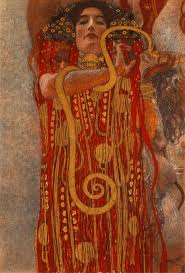
Gustav Klimt (caption later)
Gustav Klimt (caption later) Sensuality - a very Cancerian quality
Part of my excitement was probably seeing patterns that made sense to me. It reminds me of other times in my life when I have become engrossed in a particular subject that "just made sense". Virginia Woolf's stream of consciousness writing (compare this with Tracye Emin's streams of words) when I was in second grade, or the symbolism of the egg in primordial myths as they explain oneness versus dualism when I was at art college in France (and totally screwed up my chances because of a sudden fascination with academic research). On a more esoteric level, there were the explorations into the cause and effect of karma and the logic of reincarnation, explorations into the human energy system and how it relates to the rest of reality, Ken Wilber's carefully patterned theories about the evolution of consciousness, and my thesis at Uni on creativity and the inner patterns connected to it. What all these things have in common is the exploration of deep seated patterns that define reality. This moves and excites me in a way that nothing else does!
The last ten years has been a time of emotional chaos; of experiences all emotions and learning to understand them as well as deal with them. I have been burn out many times, and my attention span has gotten worse. A couple of years ago I started to want to read non-fiction again but it's slow and arduous. Yet I feel compelled to nourish my brain so that I can generate new and stimulating thoughts... I just don't want to give in to the condition.
Vivi-Mari Carpelan: "The Past Comes Crumbling Down", 2008
The dark and mysterious, or...
Vivi-Mari Carpelan: "My Secret Garden", copyright 1997 The light and mysterious...
So as usual, after a time of low and even depression, something has come together in my subconscious mind and I feel something beckoning me in a certain direction. I finally started on a piece of art that I have been thinking about for months. We could really use some money and I would be happy to sell some art. But I cannot bring myself to thinking in commercial terms. I have to follow my heart. And in spite of some misgivings, I can't stop thinking that I need to bring out the issue of chronic illness more poignantly. I've been debating how to go about it in an elegant way. Perhaps Tracey Emin and her self-disclosure has helped me feel more determined about what I probably ought to do. Only time will show what the exact impact has been. Strangely, this time I can honestly say that I feel influenced by another artist though exactly in what way is not clear to me yet.
This is the starting point of my new work. The sheet is bigger than usual, it's A1. For the past ten years I used to do small work because of many reasons: 1) I could scan them and get a good print without much trouble. 2) I could only afford buying small frames from Ikea 3) I didn't have anyone to help me so when I needed to take artwork to an exhibition it had to be managable. There was a drawback, however, which is that I wasn't able to draw much myself. My fine motoric skills have degenerated over the years. I have now decided to go for bigger images as Martin can help me with the practical issues. I want them to have more impact on the audience. I also hope that I can integrate more drawing into the images.
Vivi-Mari Carpelan: "Claude" 1993
I will be attempting to draw the figure of myself as seen on the print-out on the table. There will be a lot of copyright free men in the picture as well, so I need to do a lot of scanning. This is not easy to do since my old scanner is not compatible with my new PC, so I have to do it through Martin's tablet PC which he needs for drawing. He's getting on with his exciting illustration project for a book...
Martin Herbert - Character Study for a Book Project,
copyright 2011
Read my blogpost about Frida Kahlo as we impersonated the couple here.
Read my extensive analysis of Tracey Emin's work here.
"How it Feels", 1996 -
Still from an interview with Tracey Enim about her unsuccesful abortion
If you're a student and looking for an article on Tracey Emin, please note that the article that follows is copyrighted and may not be used in any way without my consent or proper reference to me as the author.
Tracey Emin (born 1963) is one of the world's most famous female artists. She has also succeeded in creating a fortune making self-exposing art. In the following I will be talking about her work and how it affects me as an a woman and an artist as she has helped me think about what I do. We saw her on internet television several times in recent months, probably because the Hayward Gallery in London was showing a retrospective exhibition of her work. We both had a strange feeling that we would have something to do with her in the near future. That was before we knew about the competition and that Martin would go for it. Now we are waiting with bated breaths for the results!
The day after the interview was spent on the well-curated exhibition "Love is What You Want," which includes over 20 years of Tracey Emin's artistic production. The title obviously points to the very thing we all want most of all, the one thing that means something. It was a great opportunity to see why she has become famous and what she is all about. A lot of people have prejudices about her talent and are unable to understand why she has become famous. I was however very curious about her and grateful of this opportunity.
"Since the early 1990s, Emin (b.1963) has used her own life as the starting point for her art, exposing the most harrowing and intimate details of her personal history. Sometimes confrontational or sexually provocative, her work resonates with the 'personal political' legacy of feminist art while at the same time speaking to relationships in general. Disarmingly frank and yet often profoundly private, much of Emin's art - as this show makes clear - is also animated by her playful and ironic wit." (From the description at The Hayward Gallery website)
The works quite often tend to work better as part of a whole than on their own. The works that were exhibited at The Royal Academy's summer exhibition were not particularly engaging when they were detached from a larger context. Tracey's life is her art and probably vice versa. Her extreme self-disclosure has made her a modern icon - I would say that this kind of confessional art is a sign of the times. Unfortunately, but also typically, there are many who know of her distinctive appearances and the media profile of a superstar without knowing much about her art.
Listen to this radio show about Tracey Emin's work.
The interesting thing about her work is that she provides you with all this
intimate detail, and it makes you feel that you know her really well.
Yet it's an illusion, because the more you know the more you see the gaps.
This poses interesting questions about the balance between
the private and the public self and how authentic we can ever be in our self-disclosure. Some things simply must remain hidden. Because of all this, I feel compelled to talk about her using her first name, which you wouldn't normally do when you write an article.
Tracey's art originates in various traumatic events in her life. This applies particularly to a rape when she was 13 and a difficult abortion later in life. She has lived a fairly chaotic life characterized by both roughness and vulnerability, and this is what characterizes her work. Allegedly, one day in 1998 she woke up and pondered the physical chaos that surrounded her after weeks of alcoholic living. She realized that she needed to shape up, but also that her bed and all that surrounded it (including condoms and bloody tampons) was more art than anything she had ever created by hand. "My Bed" thus became the work of art that made her famous. This was a seminal piece of art (the other one was the tent "Everyone I ever slept with", an earlier piece that burnt down), and it helped change the way people see art.
"My Bed" 1998 (installation)
Abortion is something she long processed of her art in the form of handwritten diary text, memorabilia and interviews. By sharing the most intimate details of her own life, she has fashioned an art that is both quite femininist, self-enhanced and cheeky, yet also self-doubting, vulnerable and sincere, and often a quest for a female identity. By feminist I mean the desire to assert the right of women to be who they are and standing for non-patriarchal values, as well as having a fanny! Obviously we cannot be sure exactly how honest she really is. Eg spelling errors may not always be completely genuine but could well be deliberate efforts to reproduce earlier and more spontaneous problems with spelling. On the other hand, they give rise to new associations (masturbates becomes masterbate, pity it was not master-bait!). However without them, the art would not seem quite so rough and basic. As she originally wrote down the messages in this form, the charm presumably lies in not correcting this expression, even when the text is labouriously applied to a blanket.
Tracey Emin: 'I Know I Know I Know "(neon)
- a more sophisticated version of her
text-based art in which the middle sentence is crossed out as sentences in a diary or a letter.
The neon lights are reminiscent of a form of self-disclosure that is typical of our time and all reality shows:
Often, people's innermost feelings are out in the open,
and the basis for sensationalism, the worship of individuals, self-assertion, PR of the individual, and
commercialism,
but how genuine and honest is this whole charade? On the other hand, it depends a lot on where the word originally came from.
As you follow her artistic process all the way up into middle-age there is no doubt that she attempts to be authentic, and that she is also a truly humane person. She is just as solipsistic and self-absorbed, and occasionally but not often somewhat self-pitying, as people in general are. This is not something you can express artistically without a high degree of directness and self-disclosure. She is tough but not hard-boiled - she is intelligent enough to express who she is with humour, some irony and distance, but sufficiently vulnerable not to seem calculated. You get the feeling that she is strong enough to not go under (she is definitely the surviving type) but possibly a little too weak to stop dwelling on traumas from the past. What a womanly thing this is though, dwelling and processing! I'm glad she supports this innate trait which men often scorn at. Though in all honesty I get the impression that this stage as she is approaching 50 is now over, and many of the newer works of art feel a bit empty in comparison with the bleeding wounds she screams out in her previous art. But she\s someone you cannot easily pinpoint and despite my curiosity, I feel a bit uncomfortable even trying to!
Tracey Emin: "It Always Hurts", 2005 (patchwork) There is something quite pristine, even virginal about this piece. This is probably due to the white and off white tones, which create a rather strange impression in opposition with the explicit sexual nature of the embroidery. It's as if saying, it's still okay, all this sexual violence is just part of life, and you sense that it hasn't turned Tracey into a bitter man hating person. Maybe it's even saying, all this is not so important any more.
Tracey Emin's art makes a big impression on me because there are similarities between us in the obsessive documenting of feelings and experiences in diary form, and the desire to disclose ourselves completely in order to create an honest and many faceted communication with other people. Her quilts (note that she is in a paradoxical way dealing with a traditional feminine craft, perhaps as part of an effort to strengthen her female identity - this seems to contribute to a tension between opposing drives in her life) is a kind of collage. What is different from my art and writing is that she is so raw and in the absence of a sophisticated expression. Or wait... she is unpretentious, but is she actually lacking in sophistication..? She is much tougher than I could ever be. Despite the fact that we both like to talk about trauma, there is a big difference in the way we talk about them. I can not ignore my own inner yearning for order, harmony and a sophisticated lifestyle and a certain conditioning to conforming to many of the middle class values that pervade society. Don't get me wrong, I loathe mediocrity, but I also cannot help coming from a country with much less conflict between social classes, and I feel no need to disregard the cultural background I grew up with and have no reason to reject what was in fact quite good in a cultural sense - rebellion and conflict is a source of a lot of contemporary British art. Tracey on the other hand appears to use her (presumably) simple background and chaotic lifestyle to communicate a modern and urban woman's troubled life experience. Yet there is a femininity about her that is quite compelling, In spite of different backgrounds, our aim is not dissimilar. In the end we take what is good and useful and reject the rest, I guess.
Tracey Emin: "Mad Tracey From Margate - Everyone's Been There", 1997 (patchwork)
A stream of consciousness, like a diary - Tracey Emin has mastered the art of integrating words into her art, and she plays with words and narratives, often with a great sense of wit in the true British tradition of witticism, irony and humour!
It is interesting that many of her quilts are really very beautiful and in using neon lights in fact utilizing a modern and rather sophisticated medium. I would therefore say that as a woman she is still drawn towards a certain sophistication or aesthetic orderliness. It is as if she hovered on the borders of the overly arranged and corrected without quite exceeding them. It raises questions about where the line of the brutal and crude really is and how you define beauty and the "civilized and orderly." In art, one can talk about being a dry academic or more original, spontaneous and unaffected by trends. To lean towards the less academic way in spite of an arts education and the life in a big city is unusual and probably Tracey's trump-card. By and large, Tracey Emin's art is very subjective, to the point, and in the absence of any very obviuos spiritual, social or political overtones. Although she is intelligent and wonderfully sardonic I do not know if deeper thinking about the meaning of life and the experiences of life from a broader perspective is somewhere in the background. Yet the more I know her and her art, the more I suspect that there is thought there that is not quite so obvious or in your face (she did in fact study philosophy for a while and is obviously an intelligent and researching person). And of course, it's easy to miss the obvious which is that her work is very much of our times, and is therefore a very powerful commentary on many contemporary issues, not least how women fit into modern society What I find so stimulating is that you discover more layers the more you contemplate all of this. And this is also not an elitist form of art, because Tracye's art is her and her life, and it is very straightforward.
Tracey Emin: Harder and Better, 2007 (patchwork)
The text is reminiscent of her handwritten letters,
unfortunately pictures of them are not available
but they do form an important part of her work
and there was plenty to read, often very witty. You might ask yourself, whether she herself considers her drawings as valid as the embroidery, given that it takes more time to construct the latter.
It feels like I might have something to learn from Tracey's immediacy - or perhaps she can give me more strength to expose my sore points. I have to think about it some more, perhaps it becomes clearer with time. I believe it is a sign of development and maturity that you become more reclusive over the years. I always wanted to show everything, in order to support a collective process towards more openness between people. However, there is a lot of material I have not yet published. To share in an honest way is a way of supporting humanism. At the time being, there is a seemingly unsolvable inner conflict between my desire to be open and share, and a painful fear of showing my vulnerability. Perhaps it is really about finding new ways of expressing what I want to bring out into the world. Tracey Emin really entered my sphere of interests at exactly the right time, as I have recently been pondering my artistic message and how it could be made more poignant and come across as unpretentious. Self´-disclosure must be unconditional to be true. Tracey has reinforced that in me.
Tracey Emin: "I do Not Expect", 2002 (patchwork) I could have said these exact words (the first ones) myself.
Finally, I must say that perhaps it is typical that Tracey did not want to be a mother but has a fondness for cats. In this regard, there is also another similarity between us. Her strength lies in finding other outlets for creativity than the typical conception of children and in finding a different, fertile way of existing as a woman in society. Yet I wonder how far she can get without being nourished by deep emotional wounds. It looks like a typical example of how one must suffer for one's art. Of course I don't mean that art must be this way, but I often doubt the value of art that is not born out of struggle to survive physically and mentally.
Tracey Emin: "Something's Wrong", 2002 (patchwork)
Ironically, it's Tracey's vagina (being at the centre of her art) that has brought her riches,
despite never having brought forth life - a source of inner conflict, according to herself. She is interested in what it means to give life, and how most of us need something small and cute to take care of, for various reasons.
The type of art Tracey represents feels pressing and refreshing, and it concerns me. I think she is a brave and tough personality who has steadfastly held onto her artistic ambitions. There is something for everyone yet her life's work forms a coherent whole. Above all, apart from changing the way we understand art, she has helped abolish taboos and promote greater openness - when you see her art, you can only laugh at that it still considered bad taste to display naked breasts in art here in Wales. Not forgetting that she is an inspiration because she has managed to support herself through the making of unconventional art - and though she was entrepreneurial, I don't feel that she has done all this in order to become rich. I feel like an eager art history student all over again, but with the maturity of middle-age to support my explorations. Tracey Emin has without any doubt deserved her place in art history.
The above are my own thoughts. Because of financial worries I did not think to buy the exhibition catalog, but we ordered it, and I will surely have more to say when I have ploughed through it. Read more about what critics think about the exhibition here and here . I wrote earlier about Tracey in my posts about Frida Kahlo. Read her thoughts on the similarities between her and Frida here. It is not surprising that there are similarities between all of us.
Tracey Emin: "Cat Watching", 2006 - cat watches while Tracey is masturbating. The exhibition audience was encouraged to write comments on the works of art. I wrote "The Cat Knows". It is always very amusing when the cats watch you go about your human pursuits...
Watch this video on what Tracey thinks about the meaning of art today and her encouraging words for the contestants of the Great Britons competition:
Listen to Tracey explaining the meaning of art and encouraging the participants of the Great Britons contest.
Note that she is speaking of art as a replacement of traditional religion
and museums and galleries as places of contemplation on the meaning of existence.
I find this very interesting as it is something I have recently been pondering myself.
I will come back to this later.
Vivi-Mari Carpelan: "Purification", 1997
Words are important to me, but I am aware of the fallacy of using them in a deliberate way as part of the artwork. Tracey can pull it off - not many can. I mainly stick to subtle hints and to underlying the importance of the names I give my work (as they complement the piece, and I would never call a piece "nameless"). They are often inspired, or at least they used to be (the above are not the most typical examples though), and even back in Finland they used to come to me in English. Martin wants to use text in his own art, something which echoes a certain modern attitude towards language.
Vivi-Mari Carpelan and Martin Herbert as Frida Kahlo and Diego Rivera
Nowadays you can hear almost all female art lovers call Frida Kahlo (July 6, 1907 - 13 July 1954) their primary model and example. Confessing colours and joining the throngs of admirers almost seems like a cliche. I discovered Frida in Paris in 1991 about ten years after she was rediscovered. There was a time when I seriously began to wonder if I had any direct connection to her because there were so many similarities between us. There is an extract from my diary from that time at the end of this post that explains how I felt and why. Like her, I have big problems with my spine, and began to think in terms of reincarnation. After I thought about it for a while, I did however come to the conclusion that the link was probably a coincidence.
Why is she so hugely popular? Naturally, I recognized myself in the tragedy and in the aesthetics, and I think you can say without doubt that our artistic styles bear similarities. She was quoted as saying that she is not a surrealist, as she paints her own reality, and I can also say this about my own art. As many other famous people she has reached mythic status. She is a kind of modern archetype of the suffering woman who nevertheless carries herself and her fate with pride and charisma, and later, after her death, became more famous as an artist than her artist husband Diego Rivera. I think most modern women feel they recognize something of themselves in her tragic character, or wish they embodied an equally exotic figure. The exotic allure lies in her interest in Mexican costumes and accessories, and the stoic but aesthetically so captivating self-portraits.
Nevertheless, I wanted to see if I could recreate her style when there was talk of taking part in the famous fancy dress festival which takes place every year in our town. I happened to have the right style clothes and only had to buy a few accessories. There were a couple of flowers for the hair and a dark eyebrow pencil. I had bought a pair of small shoes for a pound at The Shakespeare Company's sales, and painted them with a blue shoe paint which I originally meant for other shoes. The color was the most expensive part and unfortunately broke up pretty quickly as it didn't stick to the glossy surface. The idea of personalizing Frida was of course strengthened by the fact that I am quite small and Frida and also married to a relatively large man. In addition, like Frida and her husband Diego Rivera we are both artists, so what is not as natural as going as the famous couple! It was not so easy to find the appropriate clothing for Martin and frankly, I think the result was almost too handsome!
Cricket shirt (vintage style) was a gift from me.
The braces and the shoes belonged to the wedding outfit.
The hat was not expensive but we had to replace the band.
I am not good at sewing, especially as I have trouble with fine motor skills,
but it turned out reasonably well anyway.
It is a strange thing to try and imitate another person's style and soul, somehow it doesn't feel quite right because it's like stealing something from this person's uniqueness. Still I felt compelled to try. I placed a photo of ourselves in one of Frida's paintings and hope that she won't mind!
The dress was from Lindex and the colourful tunic from the Indiska. The necklace was from Bijou Brigitte. The earrings are Indonesian, The flowers in my hair are from the Bijou Brigitte and Tesco!
November 20, 2005
I've thought a lot about the astounding synchronism that exists between my and Frida Kahlo's life. I have several times during the week been listening to music for the film about her life, and wonder if it has something to do with me as I am now processing such difficult feelings of anger and grief .Imagine, my weak points in the physical realm are the same body parts that she had the most trouble with, ie, the spine and feet! Why did my spine collapse, while for example I do not have respiratory problems or cancer?
I also think it is noteworthy that several of my previous pieces of art are reminiscent of her work - as I recall it, I didn't see her work before she became popular again and I ran into her paintings in Paris in 1994. And even if I had seen them it seems unlikely that I would have just copied her pictures (why not De Chirico and Dali as well, for instance?). The style, which is a mixture of naivism and realism, are very similar (and it comes naturally to me). We both feel for colors, and my own "Southern" colour explosions have hit myself with amazement at times. She allegedly said that her work is not surreal, because she describes them as her personal reality. I feel the same about my own pictures. I feel that they are realistic, but in the same way that dreams can accurately depict our reality. So it is not a distorted view of reality a la surrealism, but an experience of reality that follows a completely clear and well-defined logic. Still when I was young I was drawn to surrealism, which she was personally familiar with. She also liked interior decoration. Her father was a photographer like mine. I would certainly dress like her if I had an equally appropriate appearance - I would feel comfortable in dresses and braided hair; how exciting that would be! I've always been interested in self portraits, but I have felt reluctant to make my own. To some extent she probably felt a need to assert her femininity, because Diego's infidelity certainly challenged her self-esteem as a woman. However, I can imagine that physical pain being at the center of her life, she might have been trying to create the contours of an identity that was not tied to the broken back. She was fixated on her eyebrows, they became her trademark, which confirmed her identity and individuality. Long before I knew her, I started to dye my eyebrows dark because I thought it gave my face more character .. She also liked the rain - perhaps she found it as reassuring as I do.
It is also strange that we are both deeply involved in emotional problems. She was probably not so interested in being a mother, but she was the mother of the love of her life and a compassionate teacher. It reminds me of myself. She had many friends but was anxious about not being remembered and loved (like me). She was deeply loyal to Diego but extremely frustrated with his womanising manners. She must have experienced a considerable amount of anger and a feeling of helplessness and she certainly must have brought with them into its next life! Could it perhaps also be a similar case of my anger and grief in this life ..? I bet we converge at the same point right now. I have my entire been insanely afraid of loving without getting an equal response. To become emotionally dependent on another person who does not respect the integrity of the relationship... It is certainly a powerful karma to always be treated as "second", as less important than anything else, be it personal freedom, other women, children or drugs. That one is also in terms of gender, economy and health at a disadvantage does not make things better! But somehow you have to find a solution to the problem. I can see that maybe we were tampering with the same dilemma, and that it is a dilemma that may take many lives to work out.
When Frida was approaching the end of her life she said she hopes she does not need to come back. She must have been extremely frustrated in order to say this. She was quite ruined by alcohol and medicine, and may have died of an overdose. I also find it strange that I did in fact read the biography of her life just before the movie came out, and at the same time began an affair with a (half) Mexican! The first and last movie we saw at the cinema was in fact the movie based on the biography! There is also another thing which is that I started using skeletons in my artwork. After all, it's a typical Mexican thing to let skeletons rampage. That said, it is perhaps only a matter of synchronicity, but nevertheless, I think all these thoughts have started a new process to me.
Fortunately, Martin's and my relationship is not full of infidelity and stormy as Frida and Diego, even if they were loyal to each other in the end.
MORE: Congratulations to Frida: in two days, it is Frida's birthday, six days after me, and she is one of many famous Cancerians I feel artistic affinity with. Others include: Giorgio De Chirico, Gustav Klimt, Marc Chagall, Ingmar Bergman and my young Finnish writer girlfriend Emma Juslin who wrote the award-winning Frida and Frida . The book cover was painted by her father.
The famous British artist Tracey Emin personified Frida Kahlo in a portrait of Mary McCartney in 2000 and is now available at The National Portrait Gallery in London.
Copyright Mary McCartney
Martin is working on a proposal for an image that will decorate the British Airways aircraft during the Olympic Games in London - Tracey Emin among others selects the winner. He has an idea that is reminiscent of other abstract digital works that he has done.
Read feminist Germaine Geer's article about female self-portraits and Tracey Emin's thoughts on the similarities between Frida and her own art. Hayden Herrera wrote an interesting biography of Frida, which was the basis for a film with Salma Hayek in the lead role (read what Salma itself felt about part). Funnily enough, the film came out shortly after I read the book and just before I met my half-Mexican ex-partner. It was the first movie we saw together and it made a big impression on me back then. I saw it again later and thought then that Hayek's performance was not very convincing and that the movie was dull.