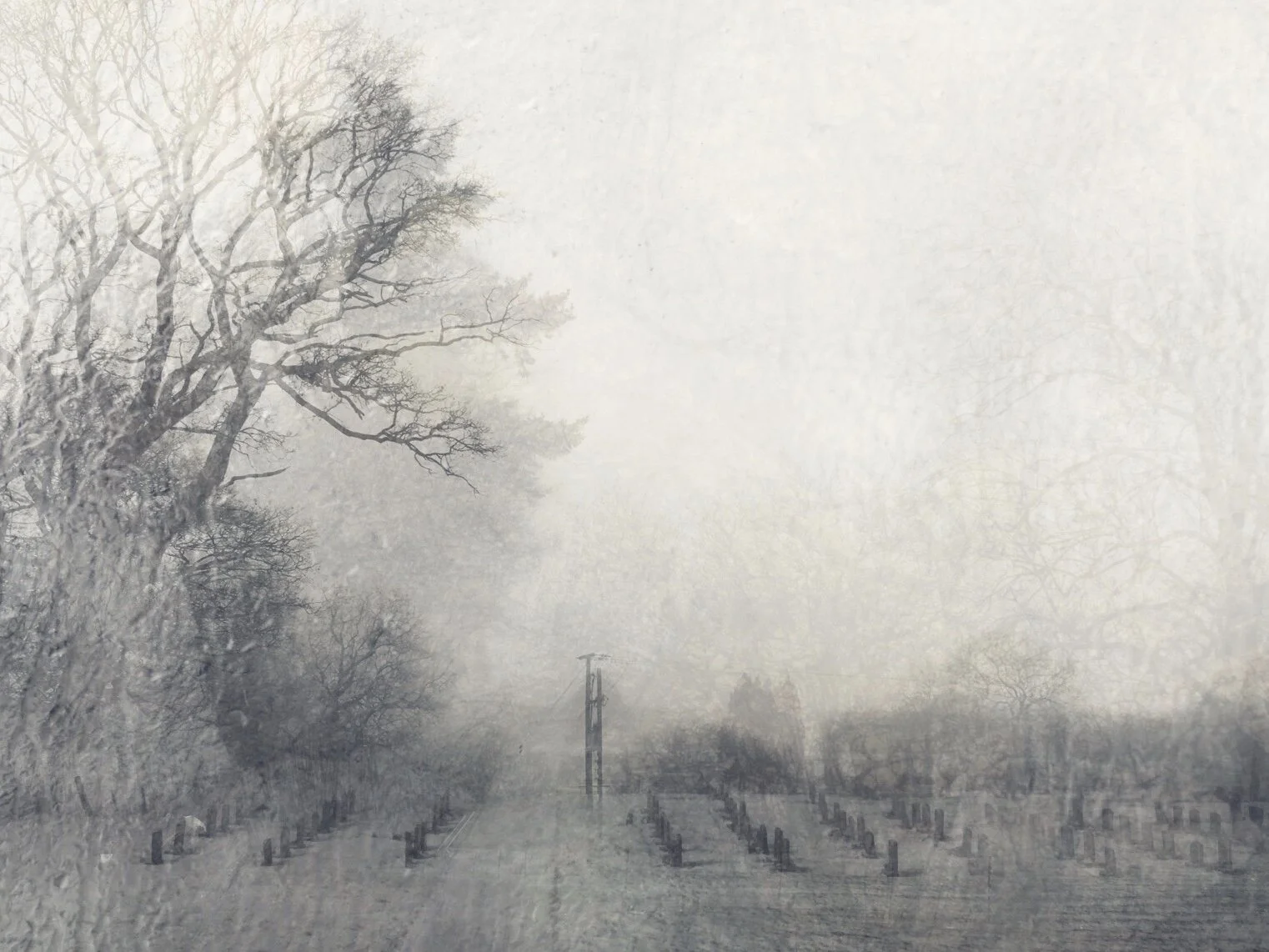
‘Shadowland’, photograph 2018
Blog posts from my website:
Vivi-Mari Carpelan is a Finnish artist now resident in Wales, United Kingdom. In her artistic practice, she has focused on the survival of the individual self in the face of the threatening Other. In this process, she has explored the liminal space where realities meet and mix. In the seam between the outer and inner, the visible and invisible, life and death, change and transformation takes place to form a new idea of self and what it means to be a human being in transition. Ultimately, it’s about the very nature of consciousness and the part paradox plays en route to a deeper understanding of the ambiguous inner realm.
Biography
I’m a photographer and mixed media artist. Over the course of three decades, I have produced symbolic drawings, collage/mixed media, abstract paintings and photographic prints, all presented on paper. For about a decade (c. 2004-2014) I dismantled material from the collective domain and reassembled it. I completed this phase by transforming appropriated moving images and sounds, and transforming them into emotionally charged films and sound collages. At this stage, the investigation was predominantly marked by deconstruction. Taking things apart and attempting to put elements together again in new configurations, was a way of looking at and redefining my idea of self and its relationship with the collective realm.
I’m a photographer almost by default, because both my parents were professional photographers back in Finland where I grew up. I now live in Wales, UK. I have recently enjoyed superimposing both old and new photographs to create a sense of the liminal space between inner and outer reality. Multiple exposure becomes a token for the surreal encounter between imagination and perceived reality and points to the transformative processes of the mind. I don’t use photoshop: instead I enter into a playful dialogue with a simple app on the iPhone. It’s an unplanned journey: the restriction of my personal freedom of choice tends to take me on routes I could not have anticipated had I tried to be more strategic. I mostly use my own work as a basis for these experiments. The series that incorporates photographs of my grandmother the prima ballerina, is an exception to this rule.
My artistic practice over the past ten years from about 2004-2014 encompasses collage art, photography, film and sound art, often using elements of performance. I mostly work with found imagery and found sounds. The objectified self is contrasted with the subjectivity of emotional truth. I aim to raise questions to do with imprisonment inside the body and mind, identity, connection, social adaptation and the survival of the spiritual self.
My work explores the relationship between the collective and the individual consciousness. How do we retain a true and honest sense of self in the face of peer pressure and social discrimination? How do you overcome the shame that comes from marginalisation? How do we reconcile with our need for approval and the sense of belonging? And finally - how do we live life and face mortality in the best possible way?
I'm a Finnish visual artist resident in Wales, United Kingdom. Since 1991, I have gone from drawing to creating mixed media collages to artist's films and sound art. Photography has always been in my life as part of my upbringing in a family of professional photographers, and became more important thanks to digitalisation. In recent years, I've been including performance art by staging myself for photographs and video clips that I use in my artwork. In this way, I'm able to highlight the semiotic quality of a decaying body - from a subjective and objective point of view all at once - and how it impacts my senses and experience of being in the world. I've always been fascinated with texture, and often incorporate photographs of aesthetically challenging yet pleasing surfaces found in the most unlikely of places into my work. 2D work that I plan for the future will be texture orientated and most likely of a relatively high degree of abstraction and definitely of high emotionally expressive value.
My personal experience of a chronic illness inspires me to promote mental, emotional, physical and spiritual health in a world mostly designed for the wealthy and healthy.
I lay out view points on the human condition, questioning the sanity of society and the collective consciousness, and seek answers to many of the challenges and dilemmas that humans are facing. My work is psychologically orientated and the survival of the individual self when immersed in the collective consciousness, as well as times of liminality and transition, are especially intriguing to me. Through a process of physical and emotional deconstruction and reconstruction, as well as seeking out the beauty in that which is old and forgotten, I attempt to bring attention to imperfection, decay, vulnerability, the value of emotions and humanness in general. I like to point to the fact that we are multidimensional beings rather than rational robots. I often employ subtle irony to underline anomaly.
My work expresses paradox, as a fundamental and crucial characteristic of reality. While ill health and alienation are linked with shame and helplessness, these can also give rise to strength of character, deeper insights into matters of life and death, and the advantage of a more objective viewpoint in regards to society at large. Afflicted with a chronic illness since childhood, Through my art, I express the idea that imperfection is human, whereas a glossy and sanitised world certainly is not. Ultimately, because I'm not a fully functioning and able-bodied member of society, neither my abilities nor my expression will ever be perfect. Human imperfection and deviance from norms is something that those who represent society still need to tackle. I believe I speak for everyone who have had to concede that they cannot keep up with the demands of contemporary society. Not until society embraces its disabled members, can it become whole.
Imperfection in all its forms is essential to a healthier body and mind. My collages, abstract photography, artist films and sound art thus tend towards that which isn't too sleek and sanitised. Apart from the symbolic language that I use, texture and layering is how I aim to express depth of meaning. My belief is that the subconscious and the conscious mind should collaborate to create something that can be understood by many people from various points of view, and isn't left to chance. I cherish figurative as well as a non-figurative expression, and often blend the two. In short, my art is about a sincere dialogue, but also about the art of living life mindfully, intelligently and deeply.
“Climate Change” group exhibition: Mid Wales Art Centre spring 2021
April 6, 2021
I’ve always been interested in the survival of the individual self in the face of the threatening Other, and paradox as key to a reconciliation of opposites. I’m especially fascinated with the liminal state between inner and outer, visible and invisible. I typically work by layering images to create a sense of the ambiguity of the inner world. It is there, that a sense of identity and wholesome relationships emerges and transforms. An understanding of the inner realm forms the foundation for a responsible restructuring of the external environment. It is only within, that the chasm between self and Other can be overcome so that both can thrive on equal terms.
As a Finnish national now resident in Wales and as a person with life long disabilities, I’ve always struggled with disorder, ambiguity, transition, change and the problematic concept of self-identification when nothing seems stable and safe. In line with my personal experiences of liminality, climate change echoes the painful process humans are forced to face when they are called to expand their idea of self and take adult responsibility not only for the health of their mind and body, but also their actions in the world. The chaos that ensues when false idea of health and prosperity crumble, puts everything we know into question.
In ‘Ciara in my Mind’ (photography, 2020), I have layered several photographs to create an impression one of the devastating storms we experienced in 2020. When storm Ciara was howling and battering outside and I was huddling indoors, I wondered how you could poignantly represent something as visually challenging, chaotic and fleeting as wind, rain and flooding - a savage, natural process that you typically don’t even get to see because you’re trying to escape it. And perhaps my point is, we must face and acknowledge the problems of the past and use our imaginations constructively in order to become a vehicle for the creation of a positive future. The monsters are really lurking inside us, and they are asking to be seen.
In ‘Phoenix’ (photography, 2019), several photographs have been layered to create the impression of destruction and change. The figure is my grandmother Edith von Bonsdorff who was a prima ballerina with the avant garde Swedish Ballet (Ballets Suédois) a hundred years ago. In fact, she was the lead ballerina in the dadaist ballet Relâche by Francis Picabia, with music by Eric Satie (Relâche means a show is cancelled). The show was the only one of its kind and a forerunner of performance art. In this image from a different show that Edith probably choreographed herself, she is impersonating a slave. (I have repurposed her stage photo to create a new idea of a stage, and so the idea of recycling things and ideas becomes part of the work.) I do see the world as a stage upon which we all perform our part through the construction and destruction of our self identity and the precariously balanced reality that surrounds us. But everything changes when you snap out of your solipsistic madness and start taking charge of the play. Then perhaps like the Phoenix, we’ll rise from the ashes.
N.B. Due to Covid, you need to make an appointment to see the exhibition in the physical world. However, it is also available to view online from the 15th April, so head over to the Mid Wales Art Centre website and enjoy it from the comfort of your couch!
June 30, 2020
Response
Three photographic works: ‘Imagination’. ‘Impression’, ‘Memory’ (2020) by Vivi-Mari Carpelan
(photos further down the page)
As far back as I can remember, I’ve been interested in expressing ways in which the intangible self comprehends itself in relation to the body, its environment, and the collective mind. To me, the world has been a stage upon which I have acted out my world view and the exhausting process of managing an unmanageable body. I’ve attempted to expose the otherwise invisible inner processes of transformation, mental processing and existential query through various artistic media. I’ve been especially fascinated with the expression of beauty through roughness and decay, and have enjoyed collaging and layering images and sounds in order to create a sense of deeper emotional truths.
Over the years, I’ve experienced increasing limitations on my ability to engage with the external world, and this has had a great impact on my art. Due to different kinds of physical limitations, I’ve had to simplify the artistic processes. In the past few years, I’ve done most of my work on an iPhone in a simple app for double exposure that encourages new associations and happy accidents, all the while reclining comfortably on my couch.
The more isolation and physical limitations I experience, the more urgently my memories seem to call on my attention. I’m forced to retreat into my inner world and explore it to the best of my ability. But I suffer from a degree of aphantasia, so my memories are not visually clear at all. To help recall visual experiences of the past, I layer photos I’ve taken in the past with current ones taken in my immediate surroundings. By layering several images I’m able to conjure up an impression of reality that says as much about my way of perceiving and processing reality, as it says about the way I observed the environment in the past. My work lies at the crossroads of inner and outer reality, in the mental melting pot where deeper meaning emerges out of a visual perception of the external world.
The series of work I’m presenting for ‘Outdoors:Indoors’ hovers in the liminal space between the reality I have perceived in the past, and how I imagine this reality in the present. A raging storm, an eerily silent church yard and the negative space of an ancient castle, may not represent your typical ideas of the beautiful Welsh landscape. This is, however, how it presents itself as a conglomerate in my immediate surroundings, in my photos, in my memory and in my imagination. The scenery appears empty because I am not there. I am not sure I dare imagine a future with myself out in the world.
The images were conceived during times of rampant storms, floods and a great pandemic. The great outdoors becomes a stage upon which the great forces of nature act and impress themselves on our bodies and minds and change our lives forever, but to appreciate the process is to imagine it.
Artist Statement:
In this work, I have layered photographs to express how my perception of external reality becomes an internal experience of the imagination. Some of the photos were taken in Aberystwyth back when I could still travel, while others were shot right outside my door and from my window.
Physical restrictions have compelled me to invent an uncomplicated way of working. I superimpose my photos on an iPhone in creative dialogue with a simple digital algorithm. I try things out and play rather than set out to control the outcome. Despite the relaxed approach, the layering transforms simple snapshots into complex imagery that feels intentional, personal and true. The method reflects my belief that limitations can encourage an expansion of the mind.
My pieces represent the ambiguous, yet stratified, workings of the human mind. Past, present and future coalesce in my headspace: memories of beautiful places co-exist with an appreciation of my immediate surroundings. All the while, the tormenting fear of never ending isolation sets the emotional tone. In addition, the forces of nature that battered our homes earlier in 2020, and the eerie stillness of death that surrounds us, all form part of a general need to cry and let go.
There is a more detailed description of my intentions in the ‘Artwork’ section: Photography 2018-2020: Mind Stuff (2020).
Audio description of the work:
For this year’s Disabiity Arts Cymru art exhibition, the selected artists were asked to participate in a workshop about audio describing their work to a visually impaired audience. I found it quite an interesting exercise and had a difficult time keeping the descriptions as short as possible. Due to worsening Hyperacusis (pain from sounds) someone else will record the blurbs.
Imagination
// This is a photograph consisting of several superimposed images that create the visual impression of a storm. The subtle monochrome hues of grey and the misty atmosphere contribute to a sense of eeriness. Images of the trunks and branches of deciduous trees have been layered to create the sense of a forest battered by a strong wind. The left hand side is in the shadow, while the right hand side bathes in light. There are strong streaks and small blotches across the landscape that suggest the movements of the storm, and a flock of birds seem to be struggling against the wind. //
Impression
// This is a photograph consisting of subtly layered images in soft hues of grey, and it looks misty, eerie and slightly surreal. There’s a spacious cemetery with tall trees to the left, straight rows of gravestones, and an erratically placed telephone pole in the middle. The background has faded into white nothingness. There’s soft, watery texture all across the picture that suggests looking through a window that’s battered with rain, and this makes the image seem dreamy. You can just about make out the shape of some trees that could, in fact, be a reflection in the window. It looks incredibly quiet, as though time has stopped. //
Memory
// This is an inverted photograph based on several superimposed images, so dark objects appear light grey against a dark grey backdrop. There’s a subtle sense of spatial distortion and ghostliness. In the background to the left, you can make out the tall Victorian memorial in Aberystwyth, some trees in the middle, and an old castle ruin in the foreground to the right. Four large migrating swans are traversing the image from right to left. The scene is reminiscent of a fading, misremembered and slightly jumbled memory. //
CONCLUSION
Due to Covid, the exhibition isn’t currently on tour, but will be presented as an online magazine until further notice. Sadly the judges of the show didn’t appreciate the thought I had put into this work. The many layers of imagery and meaning attempted to address the ambiguity between indoors and outdoors and ways in which photos and the immediate environment can serve as a point of reference for an internal process of the mind. Most importantly, I was trying to answer the question ‘what do you do if you cannot go out and take part in the beautiful Welsh landscape’. My simple answer is that you resort to your imagination. However, I am not simply pointing to the products of the imagination. Instead, I have tried to show glimpses of the inner workings of the mind themselves, as well as the ways in which I speak in dialogue with technology in order to illustrate the external, technical aspect of this process. One reflects the other in endless feedback loops. I encourage the viewer to look at the work in terms of a multifaceted reality that isn’t only about the things we see with our own eyes. I nevertheless, also want to express gratitude for the privilege of living in a country that has beauty everywhere, and not just in beauty spots. The views from my windows are really astonishing.
Disintegration and reintegration go hand in hand
November 16, 2019
Apparently I tend to sit with my feet inwards like this, and I guess it must be a symptom of my wonky bone structure and the laxity of the joints. My mum pointed it out to me once. It was Halloween, so I decided to look like a pumpkin (okay it wasn’t on purpose). On this occasion, I was feeling tired and nervous about saying anything about my work to a group of people. This photo was taken by a fellow artist..
The artists group that has been running for a year now, has kept me on my toes despite the consequences of some very serious medical mishaps that I’ve had to endure since March. There has been plenty of opportunities to show work locally, so I’ve had to sit down and push my ambitions. As always, I’m keen to explore ambiguity and liminality through the method of double exposure, and feel that I’ve made some progress. Although I’d decided to keep other people’s images out of my work, I did concede for the sake of creating a series with a strong theatrical component.
The inspiration to this work was my grandmother Edith von Bonsdorff, who was an acclaimed prima ballerina over in Finland in the first half of the 19th Century. I have been sorting out her legacy, which was basically some photos, costume drawings, written documents and medals, and donated a good part of it to the Dance Museum in Stockholm (They are in fact celebrating the 100th year anniversary of Les Ballets Suedois this autumn). The immersion in Edith’s artistic and rather ‘Bloomsbury-like’ bohemian cum aristocratic past gave me a bit of release from all the heavy stuff going on in my life and in the world at the moment. The feedback has also confirmed that people find these images a welcome reflection on more pleasant states of mind.
This is a bit like another posthumous collaboration, not all that dissimilar, in fact, to the video work ‘A Life Unremarked’. My husband had made the images (in 2014), and I provided the sound track (in 2015). What’s really upsetting to me, however, is that Edith corresponded with Giorgio de Chirico, but deemed the exchange private and burnt the letters. Privacy is an illusion, because eventually everything we own becomes part of the collective past! In this sense, the dead are very much part of the living. And I don’t think we should deprive humanity of our stories, because there is a constant need for new ones.
As I have stated elsewhere, de Chirico’s surreal art work, which he himself called ‘metaphysical’, have inspired me a great deal - possibly more than any other artist. I’m very pleased to have had the chance to roam in London while my husband was still alive, and photograph the city. These photographs now serve as the basis for my own metaphysical city scapes.
Here’s what I wrote for my website:
The stage is a series of photographs with an element of digital collage. I have used old photographs of my Danish-Finnish grandmother Edith von Bonsdorff, who was an acclaimed modernist prima ballerina and choreographer from 1919 onwards. She worked with some of the great avant-garde choreographers, artists and musicians of her time and was a lead dancer in the one and only Dadaist performance, Relâche, in Paris and the USA in 1924. It was choreographed by Francis Picabia and the music was by Eric Satie. By staging her dance poses in surreal cityscapes entirely based on the superimposition of my own photographs, I have created an impression of the paradox of performance.
On the one hand, Edith was photographed on stage while deeply immersed in her own inner world, seemingly oblivious of the observer. On the other hand, I have placed her in a contemporary environment of my own making in a way that creates an ambiguous sense of space. In some of the work, it looks as though she is reflected in a window, while simultaneously part of a dreamlike cityscape outside. Because she’s looking away rather than into the camera, it is as though I have taken her place but with the uncanny ability of watching her mirror image without the meeting of the eyes. Her external reality becomes an image of her internal self, but reimagined by myself. As a proponent of modern dance, she might have appreciated my attempt at a posthumous dialogue.
There is an ambiguity as to the identity of the observer, which is further enhanced by the fact that this work will also be seen by other people. The work becomes a contemplation on the many faceted nature of our perception of the inner and outer world. The double exposure of the two realities allows us to perform our parts in life as though we were indeed staging a performance in the theatre of life. It’s the ability to withdraw from external reality and deliberate through inner imagery and thoughts that helps objectify and learn from the roles we play. Ultimately, one may ask how authentic a person can truly be, and how the process of developing an identity becomes an exercise in choreography.
choreography.
View fullsize
October 28, 2019
At Mid Wales Art Centre, my piece Shadowland was shown as part of an exchange between visual artists and poets called ‘Inspired’. I was thrilled that Jackie Biggs chose my piece and wrote the following poem in response to it, and that it reflected my feelings and intentions so incredibly well. Jackie is a published poet living in Wales. Her blog is, incidentally, called ‘The spaces in between’.
Leaves and leavings
Her memories are fragments
taken from a wreckage of smashed mirrors,
pieced back together
so that her recollections
are only reflections of each other.
Misremembered pieces
imitate but falsify
and she no longer understands
that what she recalls
are only distorted images.
Layers of shadow on shadow
show that nothing is what it seems –
not in the past or present.
She weaves the spectres
of mis-shapen memories into tapestry
makes a new collage
layer on layer
angular fragment on fragment
and she looks through
a window, but sees
into a twisted looking glass,
her view veiled
by an apparition of herself.
Still she sees leaves,
even among winter bare trees…
leaves and phantoms of leaves,
remembrance of leavings;
and he is there, his silhouette
down there among the gravestones.
She watches where he looks
but whatever he remembers,
whatever he sees,
his memories and recollections
are obscured by light.
October 28, 2019
In this piece, I have combined several photographs, including a self portrait and the facade of a building undergoing construction work found in London once. It expresses an idea of inner reconstruction. My work explores the way in which my sense of self depends on memories and impressions from my external environment. I see the external and internal environment as inextricably interdependent, but also subject to a tug of war that pushes for change. It is an amalgam of visible and invisible aspects of reality that form an ever changing mental environment that I identify as myself. The layering of three to five photographs creates an impression of the fluid realm of the inner world, as well as the transformative forces within that can inspire various ways of reinventing the self.
My eight pieces from the series ‘Terraforming the Self’ (renamed ‘Inner Transformation’ to better suit the theme) was shown in the ‘Hidden’ exhibition at Mid Wales Art Centre in the summer 2019. Read more about the work on in the section ‘iPhoneography 2018-2019.
About the work 'Hypnagogia I-III' (2018)
February 12, 2019
Even when the external reality is the object, paintings and drawings on 2D surfaces, as well as video work, offer the impression of a ‘window’ onto an inner reality. Art works as they appear on canvas, paper or monitors, are in themselves liminal objects that are neither useful products that help us live our daily lives, nor actual windows into the inner world of meaning. Instead, art in its many forms acts as a bridge between observer and observed. This encounter coincides with the meeting of the external and the internal realm. Ultimately, the art work also provides a connecting point between the artist and an audience. Perhaps it seems self evident but in a deeper sense this demonstrates a crucial facet of our reality. It’s the eye of the Other that allows the self to identify as a self.
As the purpose of art is to evoke the human perception of reality in non-factual terms, it is mainly suggestive. Art works offer impressions of reality that are filtered through an artist’s subjective perception of their external and internal reality. The involvement of their actual ‘self’ is a strangely ambiguous affair that can never really be straightforward, and is often lost in translation. Although the artistic outcome is governed by an artist’s ability to convey their thoughts and feelings with flair, there is a general consensus that a less controlled and conscious approach will engender a more truthful impression of the inner self. Depending on their level of skill and ability to give themselves to the process, who the artist thinks they are in the moment of creative conception is thus variable and more or less successfully conveyed onto the canvas or sheet of paper. But getting lost in creative flow means that the experience can only be analysed in hindsight, and that’s when the sense of self is returned.
We all tend to gravitate towards an expression of the human form as the vehicle of emotion, and identify with the natural world as an expression of our connection to it. As viewers, we tend to anchor our perception of random shapes and forms by lending them the characteristics of people, animals and landscapes.
An attempt to break away from the representation of the external world in favour of a more abstract approach lies at the heart of modern art, of course. The dissolution of comfortingly familiar shapes and forms challenges our habitual view of reality and helps us embrace change and transformation in its multitude of forms. Conservative ideologies that resist change have nothing against the fundamental forces of nature - we can try all we want, but we cannot prevent ourselves from being an integral part of the tumult of these forces . Art is a mirror of the acceptance of the underlying intelligence of life. Not only does it say a lot about the way an artists handles reality and how their idea of self is informed by their external circumstances. Perhaps more than anything, it also exemplifies the way humans collectively try to reconcile with the relentlessly chaotic processes everyone has to put up with in order to become the best they can possibly be.
The process of making art challenges an individual’s idea of self, their sense of personal boundaries and the way in which their self occupies an aspect of reality. In short, the way an artist fills up the limited, flat area of a piece of paper offers clues about their inner reality, and the forms they choose to project onto it, are indicative of their idea of self. Yet in my experience it is a very imprecise measure of who a person really is. Although art bears the mark of an individual, to me it seems that rather than calling it a mirror of an inner self, it’s more appropriate to call it the reflection of an investigative and restructuring process of the mind.
As an experiment, I wanted to break away from two things that had preoccupied me in the past: the appropriation of copy right free material from the archives of the collective mind, and the habitual use of figures to express subjective feeling. The image of humans inhabiting an imaginary space on a flat piece of paper was troubling me. The emergence of figures during the process seemed to compel me to think about the temporary conditions of my life circumstances, and I wanted to get away from the narrowness of this view. Whether or not the images looked like me, they would invariably express my ideas about the human condition from my current perspective. This representational way of working held me captive to a conventional story line about a self that one could project as an image, and manipulate through paints and crayons in order to express a variety of psychological conditions that seemed to belong to it. I was troubled that for as long as I incorporated the figures of humans into the work, I could not get away from the expression of a limited idealised self and its narrow-minded subjective point of view. It was all very well to communicate this particular appreciation of reality and share it with others who were able to relate to it. But I wanted to liberate myself from my current self-centred narrative at least a little bit and see if I could distance myself from the stories about the human condition and the emotions that we all share.
Seeing that my life circumstances confined me to working on a 2D surface, I had to accept the limitations of the neatly circumscribed arena or ‘flat theatrical stage’ of a sheet of paper. I decided to do away with the human figure and express a less ego-centric approach to reality. The work would still be a testimony of my individuality. But maybe my efforts to dissolve form would stipulate an illusion of distance. like a softened version of objectivity without the association to cold, clinical fact. The result became a meditation on the way in which both a subjective and objective view point could co-exist as a less tightly wound expression of who I currently think I am.
It was quite interesting, that the pain and exhaustion caused by my physical disability was preventing me from making strong marks with pens and crayons. As soon as I started to get nit picky about the quality of my lines, my hand started to cramp. I was working on big sheets of Indian Khadi paper (70x50 cm) that I’d inherited from my deceased husband. Tte fair size of the paper and my attempts to loosen up my work process forced me to move around a lot and bend over in ways that challenged my physical stamina. In the end, I could only do what I could do. But I did find a painterly way of working that overruled rationality and put me in greater touch with my feeling self. In addition, I played with chance in order to create a greater sense of the organic uncontrolled movement of life itself.
The emerging work became an image of process. More specifically, it mirrored my understanding of the space between the visible external and invisible internal reality, and thus continued my previous explorations of liminality. The name ‘Hypnagogia’ is derived from sleep research, and it denotes the stage between wakefulness and sleep. During this stage, the perception of physical reality breaks down. Rational thoughts turn into irrational ones. After a period of dreamless sleep, consciousness undertakes hallucinatory journeys marked by a lack of all the physical constraints that come with life in the waking world. My work plays with the idea that you cannot appropriately describe on a physical piece of paper how the physical turns into the non-physical. You can only do your best to suggest it. On the other hand, the nature of ambiguity is best expressed in ambiguous terms, and it is something other than a logical analysis. (You might ask whether the brain is doing the hallucinating. This is not the place for an in-depth discussion about the nature of consciousness and whether or not the experience can be reduced to neurological activities in the brain. Suffice to say that I am not personally in the least bit interested in the brain though it obviously has its place as a coordinator of perception.)
When an individual falls asleep, the conscious self-agency breaks down in favour of a narrative they cannot control, and unless the dreamer is lucid, it’s seen from the point of view of a self that does not comprehend itself as a self. Like the skilful artist has to surrender to mind wandering and the expression of spontaneous creative gestures, the individual has to surrender to the process of falling asleep and allowing their unconscious to do its job.
When the propensity for a surrender of the conscious sense of self is hampered, the creative aspect of one’s being is also challenged. One could say with the Chinese that the waters are muddy and do not clear up as efficiently as they would during periods of good health. My artistic work is the paradoxical outcome of a great struggle with this particular aspect of reality. I felt that by removing references to the human form and conjuring up as non-generic a world of form as I could possibly muster, I could at least suggest something about this state of consciousness through art. I allowed myself a modicum of physical involvement in the mark making process and discovered moments of meditational flow that allowed me to loosen up the tight control of my conscious mind. I could bypass some of my concerns about who I was trying to be. But I also decided that I needed to balance all this with a hint of rationality. I anchored the chaos in recognisable shapes that point to metaphysical descriptions of the nature of reality. It means that a rational world view about past, present and future has also found its place in the work. It is nevertheless never fully spelled out and is entirely open to subjective interpretation. For instance, if people see commonalities with Extinction Rebellion, it was not something I was aware of a the time but am not opposed to seeing as part of the interpretation.
My ‘pointer’ towards an ambiguous aspect of reality is still as gross and tentative a representation as the ambiguity it’s trying to express. By not framing the work, I wanted to put the idea of a ‘window’ in question. I’ve tried to point to the individuality and tangibility of each of the sheets of paper I’ve been working on, as well the ambiguity of the boundaries of the work and its environment. Hopefully the work offers a small ‘opening’ into the realm of the inner self as it could appear when the individual nods off, the sense of self dissolves, and consciousness goes about its job of restructuring the matrix of the body and the world within. But it’s also part and parcel of the context it appears within.
IN THE WORDS OF OTHERS
The authenticity of Vivi-Mari Carpelan's works is exemplary. In her collages and video works, Carpelan courageously strips away layers of convention, routine, and social acceptability to reveal the magic and mystery of what it means to be human in a manner which transcends individuality and invites her audiences to enter her world and share in her explorations. Tämä on taidetta, joka koskettaa sydäntä ("This is art, that touches the heart") ( Jonathan Talbot, artist and editor of collageart.org), New York, 2014.
Fabulous music! Well done, Vivi-Mari. Like nothing else. I'm drawn to what you are doing because it's genuinely uplifting and disturbing at the same time! (Nigel Evans ("Scribbleman" at Greed The Rock Opera) musician, journalist and arts marketing officer, UK, 2014
I've just finished watching Tides and it's so haunting..... I think this is furthered by your soundtrack... I was going to ask where the music is from, but I see from your blog it is an amalgamation of different sounds both captured and staged. I found the film very sad but also that there was a sense of liberation and freedom in this. It reminded me of the work of the Japanese directors like Hideo Nakata. (Beth Davies-Hofbauer MA, visual artist, UK 2014)
All your work contains presence and a deep understanding, almost a kind of mediation, and they convey interesting messages and viewpoints. I have never had the desire to own anybody else's artwork. This tells me something, which I find difficult to put words to. I experience your art in a strong and special way. Even after seeing just a few of your previous pieces a long time ago, I started to cry. I felt that from your brush, something that I was pondering and experiencing on a deep level, came into being - something that I didn't have the means to express, but you did. You make something within me physically visible and in a way that is 'wonderful' and perfect, sarcastic, teasing, insightful, deeply artistic, wise and a kind of message, too.
It feels as though you look at something from the outside and make it visible to others, but at the same time you're in it and the art is very much a part of you - this is all thrilling and perfectly new! I'm not sure why, but I always experience your work - also the multimedia projects - very profoundly. I really come to life when I encounter you and your work. To say that I love your work is not enough. Somehow they really nourish me and I stay hungry after each one of your pieces... It's like a passion... and believe me, I'm not exaggerating in the slightest! (Kirsi Salo, senior legal adviser for the Finnish film industry, Finland 2013)
This is absolutely splendid work. You combine the photographs of yourself with everything else in each collage in a seamless manner; the result is a unique dialogue between Self & Self-Who-Is-Other. It is a visual narrative that when viewed in its entirety flows from picture to picture like a stream of successive scenes in a diary. (Eric Edelman, collage artist at RetroCollage, New York 2012)
I honestly think the smarter you are the more unsatisfied you can be... because there is so much to see with your eyes so wide to questioning life and purpose and the rest... one thing I feel sure of is that whenever you can honour your talents you should. Perhaps sometimes that is all you can do. And you do it with finesse! I can see something burning in your work.. there's definitely fire in it... and whatever the roots are.. you are using them... which is of course brilliance! You mustn't be ignorant and I'm not sure you could be if you tried.. your eyes are wide open. Like I said... think your coming to a flourishing point. Gotta say wow to your boldness and bravery and it reminds me a tiny bit of Gilbert and George...
in the body revealing and the partitions... now they are great... you are great… these are the guys who love the aesthetic of surfaces and science... I'm sure you already know who they are... but they have one another to hide behind even with their revealings... the woman that does this alone... if we were to align to a tracey emin paradigm then she is self revelatory… she is not the first, she is just the exposed one, so like herself... You are a pioneer. (A visual artist, 2012)
'THE TIMES OF MEMORY'
Collage—an art technique which blossomed during the twentieth-century—displays on a two dimensional surface images and texts from various sources, constructing these into a complex and dynamic whole, the component images retaining their own independence as recognisably distinct in style and origin.
Vivi-Mari Carpelan's contemporary collages are profoundly noteworthy. In their enactment of deep symbolic logics, they do nothing less than re-configure time.
Some of the source imagery comes from Hindu art, evoking an ancient and ongoing tradition. Other imagery originates in advertisements from past decades, evincing a nostalgia where loss can never quite be recovered or redeemed. Still other imagery comes from prints of Neo-Classical architecture, a building style that resurrects the antique past in producing stone monuments that defy the ravages of time. More haunting and playful are skeletal images of extinct species, tokens of the arising and perishing of all particular life forms within a vast and mysterious evolutionary unfolding. The esoteric and alchemical diagrams dispersed throughout key an anticipatory time proper to secreted promises yet to be revealed.
The space of these collages is thus the arena of a profound mode of Memory (an inflection of Consciousness itself)—a Memory that is prior to any given form or feel of time, and which accommodates all such forms, allowing them to reverberate with each other through the part/whole dynamic of the collage construction. This is an Art of Memory that is not simply retrospective and receptive, but powerfully and profoundly Creative: the interplay of the imagery sparking novel senses of time—transforming the Self-sense so tenderly and vulnerably at stake in these works. (Michael Schwartz , Professor of History and Philosophy of Art, Augusta State University, Augusta GA, 2011)
PHOTOGRAPHY 2018- 2020
Since both my parents were professional photographers back in Finland where I grew up, I’m a photographer almost by default. In recent years, I have been interested in superimposing photographs both old and new to create a sense of the liminal space between inner and outer reality. Multiple exposure becomes a token for the surreal encounter between imagination and perceived reality and points to the transformative processes of the mind. I don’t use photoshop: instead I enter into a playful dialogue with a simple app on the iPhone. It’s an unplanned journey: the restriction of my freedom tends to take me on routes I have not anticipated. Only a few images incorporate visuals that aren’t originally my own: these are photographs of my grandmother who was a prima ballerina at the famous Le Ballet Suedois in Paris in the 1920s. All other images that feature people are sublimated instagram selfies.
My work takes inspiration from the paradoxical ‘ontological loops’ that define the matrix of reality, and in my mind, consciousness itself. Contemporary consciousness research that likens our reality to a computer simulation, suggests that external reality does not exist independently, but is really a product of complex processes of perception. Of course, the brain is also part of physical reality, so it’s interesting to ponder the extent to which the brain is helpful in achieving this goal, and where it simply fails to explain the origin of such complex computations (in science, this is called the hard problem of consciousness). Without going into scientific speculations about the nature of reality itself, I’d like to propose ways of observing and imagining the points of connection between internal and external reality and the metamorphoses that occur in this most ambiguous and unattainable realm of reality-construction. On the one hand, this work, like any work of art, is a product of my mind. On the other hand, I have attempted to depict the mind itself by offering glimpses of its processes and whatever contents my mind happens to be focusing on. You might say, that the images resemble still frames from a movie of the ongoing processes in the headspace. The work is an ongoing experimentation with the idea that the mind can be made the most visible, not just by representing imagery of the mind through mind-reading devices, as some researchers and artists are attempting to do, but by using its most powerful tool, which is the imagination. This is a visual form of meta-analysis. How can the mind, which is busy dealing with the outside world, also perceive of, and describe, itself?
‘Terraforming the Self’ (2018) is a photographic project that investigates the self-explorative function of Instagram selfies by taking them to an new level of self exposure. Through the layering of multiple photographs (i.e. double exposure), I have sought to express the reinvention of self through transformational processes, and offer a window to an idea of self-identity that goes beyond that of the physical body.
The origin of the project’s name is the scientific proposition that other planets can be made inhabitable through the artificial induction of a climate. Not only do I find the idea of humans as creators of a twin planet a fascinating prospect that could be helpful to the survival of Earth, I also see it as a metaphor for the future self. Rather than seeing the possible colonisation of another planet as an escape from our responsibility for Earth, I see potential for increasingly higher forms of creative and scientific innovation. Yet for a brighter future to be possible, it is really the narcissistic ‘Planet Self’ that needs to be terraformed first. A new mental climate becomes an idea of a new self.
Using personal photographs both old and new (usually about 3-5 per project), the all the images have been produced on an iPhone. Nine basic filters for double exposure have been used as a way of creating impressions of the dreamy world of the inner self, and no other ‘trickery’ has been employed. As a metaphor the chaotic nature of evolution, chance has been made to play a part. In the tension between the world of inanimate technology and the virtual world of the mind’s eye, a new world and a new idea of self emerges. It’s a new identity that is not based on the body and its condition, but on the invisible inner self and its expression in the visible world.
‘Terraforming the Self’ is a project (2018) that investigates the self explorative function of Instagram selfies by taking them to a new level of self exposure that reflects inner change and transition.
I have appropriated the Instagram style selfie with the intention of bringing to light a complex inner self that transcends the confines of mere physical appearances. Although it’s natural to seek to know oneself through the observation of one’s body (and this is made increasingly easy and fascinating through technological advances), to find ways of grasping the inner world and an idea of one’s hidden identity, is a much greater task. The hidden realm of introspection (the observation of mental processes) and interoception (the experience of internal states of the body) is notoriously elusive. Through the layering of multiple photographs, I have tried to find a way of objectifying the hidden workings of the internal self that lurks behind the solid facade of the external self, and highlight its propensity for change and transformation.
Photographs traditionally freeze a moment in time, and mental and emotional states can only be hinted at. By superimposing various abstract and representational photographic ideas on simple selfies, I have sought to represent the complex and creative associations that mark the ever changing nature of the processing mind. In the process, I have also asked myself questions about my own invisible inner identity, and how to best align it with the limited means of the visible world.
The title of the project suggests that every human is on a quest for a greater sense of identity, and that we must all fully understand the implications of ‘Planet Self’ in order to create a new climate that sustains life. While dealing with polluting ideologies of the past and finding solutions to the problems we’ve created, we are forever reinventing ourselves. From this perspective, the cliched and apparent narcissism of Instagram selfies can be seen in a more forgiving light: we are all on a quest to understand who we are and what we wish to become. We are forever seeking mirrors in which to reflect our idea of self.
MANIFESTATION (2019)
Manifestation I-IV (2019) is a series of photographic works that explore ways in which accidental occurrences coincide with conscious agency to produce new states of form and being. While I quite literally create my work in this way, my intention is also to visually suggest it. I see the manifestation of potential (i.e., revealing something hidden), as an interdependent, dynamic process of destruction and construction.
Liquids that have boiled over on my stove and cracked glass are real life accidents that have turned into a speculation about the way destruction and construction are so interdependent that it's often hard to tell them apart!
View fullsize
View fullsize
View fullsize
View fullsize
THE STAGE (2019)
The stage is a series of photographs with an element of digital collage. I have used old photographs of my Danish-Finnish grandmother Edith von Bonsdorff, who was an acclaimed modernist prima ballerina and choreographer from 1919 onwards. She worked with some of the great avant-garde choreographers, artists and musicians of her time and was a lead dancer in the one and only Dadaist performance, Relâche, in Paris and the USA in 1924. It was choreographed by Francis Picabia and the music was by Eric Satie. By staging her dance poses in surreal cityscapes entirely based on the superimposition of my own photographs, I have created an impression of the paradox of performance.
On the one hand, Edith was photographed on stage while deeply immersed in her own inner world, seemingly oblivious of the observer. On the other hand, I have placed her in a contemporary environment of my own making in a way that gives rise to an ambiguous impression of the space around her. In some of the work, it looks as though she is reflected in a window, while simultaneously part of a dreamlike cityscape outside. Because she’s looking away rather than into the camera, it is as though I have taken her place, albeit with the uncanny ability of watching her in a way she could not. Her external reality seems to reflect her inner world, but it’s reimagined by myself. I should add that as a proponent of modern dance, she might have appreciated my attempt at a rather surreal posthumous dialogue!
There is an ambiguity as to the identity of the observer, which is further enhanced by the fact that this work will also be seen by other people. The work becomes a contemplation on the many faceted nature of our perception of the inner and outer world. The double exposure photography reflects the mingling of these two aspects of reality. I do see the world as a stage: we act out our parts in life as though we were indeed staging a performance in the theatre of life. It’s the ability to withdraw from external reality and deliberate through inner imagery and thoughts, that allows us to objectify our experience and learn from the roles we play. Ultimately, one may ask how authentic a person can truly be, and how the process of developing an identity becomes an exercise in choreography. Perhaps we are reinventing the self a lot more than we even realise...
View fullsize
View fullsize
View fullsize
View fullsize
View fullsize
MIND STUFF (2020)
In this work, I have layered photographs to express how my perception of external reality becomes an internal experience of the imagination. Some of the photos were taken in Aberystwyth before I was involuntarily subjected to multiple major surgeries, as well as the necessity to shield because of Covid-19. Others were shot right outside my door and from my window. For instance, the trees and the surreal take on a cemetery are part of the views I enjoy in my home environment. The overall work nevertheless expresses the way I perceive of reality in a deeper sense, and it includes rather than excludes the actual workings of the mind that creates a concoction of reality and then tries to replicate it. You can photograph the effects of a storm, or the consequences of death, or places you’ve visited, but you can’t easily express the nature of such elusive phenomena and experiences without resorting to the tools of the imagination. But then you can also look at your images, memories and the process of the imagination, and make something of all that, as well.
Physical restrictions due to a chronic health condition have compelled me to invent an uncomplicated way of working. I superimpose my photos on an iPhone in creative dialogue with a simple digital algorithm. I try things out and play rather than set out to control the outcome. Despite the relaxed approach, the layering transforms simple snapshots into complex imagery that feels intentional, personal and true. The method reflects my belief that limitations can encourage an expansion of the mind, but also, that technology can become an extension of the mind. There’s a simplicity in all this that actually reflects a complex computational process of observation and meta-observation where the mind is trying to get hold of itself and not only see what it produces, but also what it is.
My pieces represent the ambiguous, yet stratified, workings of the human mind. Past, present and future coalesce in my headspace in a paradoxical way: on a positive note, memories of beautiful places co-exist with an appreciation of my immediate surroundings. Yet all the while, the tormenting fear of never ending isolation and the eerie atmosphere in the world at large, sets the actual emotional tone. In addition, the forces of nature that battered our homes earlier in 2020, and the stillness of death that surrounds us, all form part of a general need to cry and let go.
Please read more on my blog.
View fullsize
HYPNAGOGIA I-III (2018)
“Hypnagogia” (2018) is a series of abstract mixed media works on paper that explores an idea about the liminal space where opposite aspects of reality meet and join hands in a paradoxical encounter. As a result, old structures fall apart and new associations are made.
View fullsize
View fullsize
View fullsize
Hypnagogia I-III is a series of mixed media works that represents the liminal realm between wakefulness and sleep. It is, in other words, the threshold to an entirely different state of consciousness. Here, and just barely out of sight from our conscious attention, our waking perception of linear, objective reality breaks down. The dismantling of the waking perception serves to pave the way for the multilayered narratives of the inner self during sleep. This brief and elusive state usually appears nonsensical, though it has also been known to offer creative insights and emotionally meaningful hallucinations. The inner reality complements external reality, and the two are best seen as interdependent and complementary experiences that cannot exist on their own.
During the process of painting this work, I tried to loosen conscious control and avoid generic symbols that would direct the viewers analytical thinking into certain stereotypical concepts. The triptych aims to highlight the idea of elusive metaphysical principles as they form in the mind and gradually lead to a clarity of understanding. The formation of new insights demand that old conceptual constructs are broken down and destroyed, but the process of destruction and construction does not necessarily appear linear. In this work, there is an idea that past, present and future need to connect in the mind of the person who aspires to get a better hold of their sense of identity and who they are in relation to the rest of the universe. The present is a melting pot of past and future, and the formation of insights and connections asks for a meditative state of mind that is essentially hypnagogic in character.
Read more about it on my blog.
SOUND COLLAGES
AN EXPLORATION OF LIMINALITY AND RECYCLED SOUNDS (2014 - 2015)
MUSIC FOR LIMINAL TIMES
"Music for Liminal Times" is a set of audio works at the intersection of music and sound art that explores liminal space. To exist in a liminal space is to be in physical and/or psychological transit while moving from one state of being to another - it’s the transformative and archetypal "threshold" of extraordinary times and experiences mostly marked by chaos and ambiguity. These transitions and crossings are journeys within the greatest journey of all. Themes that I have explored within this framework include love as a peak experience, meditation as an inner journey, the desperation that drive us to seek transitory fame, war as a state of mind, the creative process, and the sounds and historical documents found in the public domain, I have set out to evoke the essence of these journeys. This project brings out the tensions between dichotomies, not least the opposition between the individual and the collective consciousness, past and present, old and new... An awareness of the external expressions of the past and one's inner workings in the present are necessary for the evolution of an improved future.
These soundscapes are an aural equivalent to the visual collages I also typically make using imagery of the public domain. Although the sounds are digitally processed, they connect with the tradition of manually manipulating tapes to create experimental sounds. Creating something entirely new out of something old was the challenge I set myself, but it was in many ways a project that opened me up to the art of listening and to a new creative expression. Classical music gained a new meaning through my interventions, and old historical documents that speak of human sentiments, ranging from aggressive to humble, often moved me to tears. The vintage aesthetics of old distorted recordings have been used as an ironic device, as well as highlighting the juxtaposition between past and present. It express the idea that history is the glue that holds all things together - an appreciation of lessons learnt is necessary for a conscious evolution to take place. It also expresses the fact that some things in life simply never change and rather rotate in a cyclic fashion along the spiral of evolution.
Playlist and lossless downloads on BANDCAMP.
TRACK 1
"The End is a New Beginning" is an emotionally charged piece of music that talks of the languid melancholy of going through times of change. Though it has its unique flavour and is based on heavily deconstructed classical music from the Renaissance and Baroque era without inclusion of other sounds and documents, it sets the emotional tone for the album.
TRACK 2
"The Unexpected Longevity of Love" explores the way the ephemeral peak experience of love takes on an enduring quality. The imperfections in old recordings are here used to express the fundamental and very primordial, yet also very human and therefore often somewhat flawed quality of these kind of sentiments.
TRACK 3
"The Futile Pursuit of Becoming Famous" is about the transience of life. It is an emotionally charged and ironic piece of music about the erratic nature of fame as well as the desire to be one of the few chosen ones. In a sense, fame is truly liminal because it comes and goes like the weather. The vintage aesthetics of distorted recordings expresses the idea that humans just never let go of this pursuit, it's like an old record that's stuck in its tracks. The desire to be admired is surely as old as consciousness itself.
TRACK 4
"The Strange Anatomy of a Journey" is about the transition from one state to another. It's a journey that can be external as well as internal, and more specifically related to the experience of meditation and becoming aware of psychological events. Cultural references awaken the idea of journeying through sound out of our arm chairs into unknown lands.
TRACK 5
"War and Peace is a State of Mind" is about the eternal recurrence of conflict and harmony, and how the murky recesses of the individual and collective consciousness reflect the state of the world. According to a Taoist way of looking at reality, polarities are fundamentally interconnected and not in conflict with each other - the conflict lies within the human mind. Life has a cyclical quality, as polarities (yin and yang) shift from one to another. One can't exist without the other. War can only exist as a counterpart to peace, and vice versa.
We think of war as liminal, i.e. “out of the ordinary”, but this is not quite true if we look at war and conflict in its broadest sense. Conflict/chaos/instability is as frequent as the lack of these. This is as much an external reality, as an internal one. To realise the nature of the semantic tension in our minds and thus transcend it, is surely a way of dealing with the urge to exert aggression towards one another.
The way the world runs the conflicts at present is patriarchal (note the lack of women in the piece), but thanks to evolution, expressions of disagreement and power eventually change over time. In the end, the concept "war and peace" is no doubt less about what it represents to us in our minds than how we may reinvent these concepts and seek less destructive ways of dealing with challenges within ourselves and in relation to the rest of the world.
The theme in the beginning is not from an ice cream van, but a theme (the Swedish Rapsodhy) that is said to have been used as the interval signal for a German language numbers station during the Cold War. The idea of weird codes being transmitted through the air is somehow alluring and creepy, but also quite a strong metaphor for the secret world of the collective unconsciousness.
Please read a more in-depth explanation here.
TRACK 6
"Creativity Will Set You Free" is a sound collage that references Mihaly Csikszentmihalyi's famous theory about creativity and flow and imagines what the creative process might sound like. It suggests, that happiness is dependent on our level of creativity. The experience of creative flow is a peak experience and therefore liminal in nature. The creative process in itself is, however forever ongoing unless obstructed. It manifests phases of research, inspiration and energy, but also times when one gets stuck and finds it difficult. This piece contains many references to space and water, two powerful symbols of creativity. One suggests that it can be an otherworldly experience that has something in common with flying, and the other that it requires a connection with the intuitive and emotional world of the subconscious mind. It appears to be one of the few things that can make us feel true happiness.
Please read more on my blog.
This piece was played on BBC Radio Wales on Saturday 7th June 2014 at 22 pm.
TRACK 7
"The Crossing" is an emotionally charged sound collage with an archetypal ambience in which I have imagined the ultimate liminal experience that is inevitable for all.
This piece is about the anticipation of death, the way people talk about death, about the fear of death, the process of death as suggested in art, literature, films and testimonials, as well as a hint at the ambience of the beyond. It has Western as well as Eastern elements in it, of the past as well as modern times. It is about myself as much as it is about the collective. This piece is also a metaphor for the transformative process of psychological death during times of hardship and inner change. Contemplating our mortality in a world that trivialises death can surely bring us closer to life.
“Life and death are one thread, the same line viewed from different sides.” (Lao Tzu).
A long Way to Heaven is a soundscape that comments on the over mechanised aspect of society today and the impact a stressful environment has on the individual. This track will be part of an upcoming artist film about the way a world dominated by a warmongering mentality causes the individual to succumb to life threatening stress disorders.
Please view the film "I Got Life" with this soundtrack here.
Please view my artist film with this music here.
A Life Unremarked is the soundtrack for a video art work, A Life Unremarked, from April 2014 by my late husband Martin Herbert.
I discovered the unfinished video work after his death and decided to do a posthumous collaboration by adding an appropriate ending and a soundtrack.
Martin's project was exploring the premise that the skills of the generalist or polymath are not valued in our society - that individuals are only well-regarded if they become 'experts' in one narrow field. People in today's world are able to do extraordinary things and have adventures that only a select few could even have dreamt of in the past. Because of an inflation in personal feats, they tend to go unnoticed. Ironically, Martin's own life as a polymath ended prematurely and thus his desire to become noticed for the great art he was about to make was cut short and disappeared into the mist of an anonymous past like all the other interesting things he did in his lifetime.
Because of Martin's premature death and the nature of the music I conjured up without much conscious thoughts of what I wanted to achieve, the impact no doubt diverges from Martin's initial intentions. The final product is uncanny and hints at the idea that we sometimes may have premonitions about our own death. The work takes on a whole new meaning as describing the transient nature of a prematurely ended life and its impact on those left behind.
LIMINALITY
The word liminal is an intriguing word. Liminal is originally an anthropological term that denotes times of transition and change. It's a time that is out of the ordinary. It can be a rite of passage, it can be times of war, it can be crazy carnival time, it can be times of relocation, or times of inner change. These times are archetypal thresholds, usually marked by disorder, chaos and ambiguity until a new order ensues. All of these situations are interesting from a psychological point of view because they help us evolve, on a personal level as well as on the level of collective consciousness. I find that I am really quite fascinated with the way collective consciousness interacts with the individual consciousness, often in a compelling, yet also distressing, way. To withstand this influence and retain personal integrity is difficult. However, I believe that awareness of this and how we transit from one stage or level to another is quite important to a more fluid experience of life.